

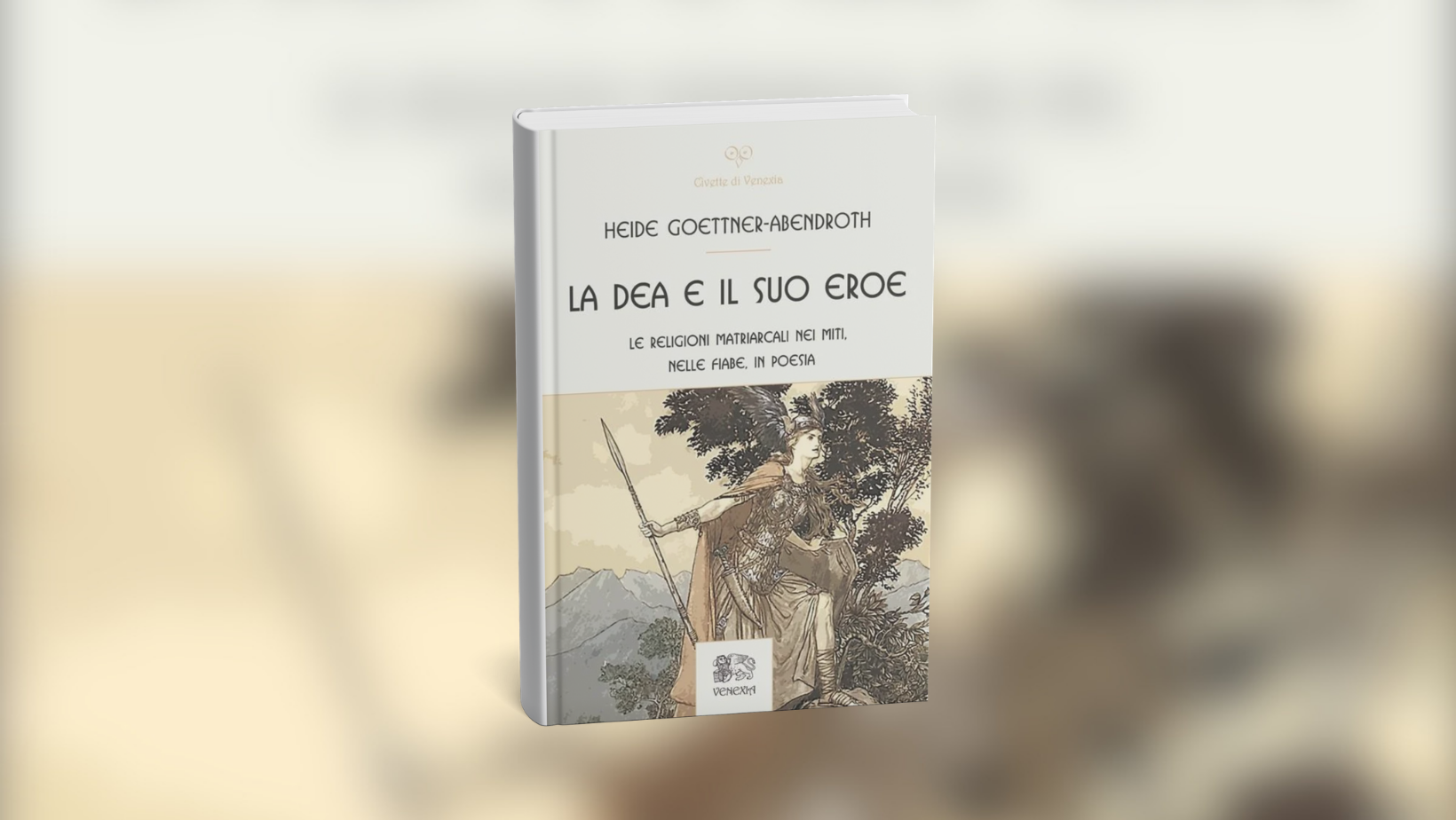
The Goddess and Her Heroes
There was a time when the hero was not an exterminating warrior, but a human being whose energy was at the service of nature and community. Heide Goettner-Abendroth traces ancient matriarchal mythologies in patriarchal myths.
Review by Claudia Mazzilli
One of Heide Goettner-Abendroth’s first works, The Goddess and Her Heroes, is finally available in Italian as “La Dea e il suo Eroe. Le religioni matriarcali nei miti, nelle fiabe, in poesia” (Venexia publisher, 2025, translation by Gabriella Galzio and Christina Jenkner), but the first edition in German is from 1980 (Die Göttin und ihr Heros: Die matriarchalen Religionen in Mythen, Märchen, Dichtung).
Heide Goettner-Abendroth (hereinafter HGA), the foremost expert on matriarchal societies of the past and indigenous societies that still exist, as a twenty-one-year-old student was struck by the reading of the work The Greek Myths by Robert von Ranke-Graves, whose historical perspective included the era (lasting at least eight thousand years) of matriarchal societies and their Great Goddesses. HGA does not consider myths as static narratives, but as repeatedly remodeled narratives, to be interpreted not for individual reasons and symbols, but within broader contexts, so as to recognize the structures relevant to each stratification (synchronous method), and then analyze how the structures have changed in successive stratifications according to rules that have as many political-social transformations in the background (diachronic method).
The mythologies of the vast region stretching from India to Europe, via Western Asia, Egypt and the Mediterranean basin, were only recorded in writing during the Patriarchal period (3,000–2,500 BCE in Mesopotamia and Egypt; 4,500 BCE in the Black Sea region; 1,450 BCE in Crete). However, it is possible to recognize the pre-existing supporting matriarchal structure in myths, through a historical-social interpretation and a comparative, interdisciplinary and critical analysis of the ideology of patriarchy, according to a method already initiated by Marie König (expert in prehistory) and Marija Gimbutas (archaeologist). König avoided the term “matriarchy”, Gimbutas preferred to speak of “matristic societies”: both feared that matriarchy was understood as a mirror reversal of patriarchy, that is, as the domination of women (such a model of society has never existed). In all her texts, HGA specifies that her four-level structural definition of “matriarchy” corresponds precisely to the intentions of the two scholars: matriarchal societies are therefore those characterized not by domination but by consent (political level), not by the economy of profit but by the economy of gift (economic level), not by hierarchical relationships between man and woman but by egalitarianism, gender cooperation, matrilineality and inter-generational solidarity (social level) and by symbolic systems based on the harmonious and non-predatory relationship with nature and on the life-death-rebirth continuum (cultural level). These societies were destroyed by overlapping Indo-European or Akkadian patriarchal conquerors, bearers of social systems based on domination and mythologies based on warrior force and violence.
First of all, it is necessary to outline the structure of matriarchal religion defined by HGA, which provisionally uses the term “religion”, because divinity in matriarchal cultures is something immanent (religious in fact means “reconnecting” to a transcendent god that cannot be experienced and to which, however, one must believe); the Goddess, on the other hand, is the entire cosmos, not something abstract, she is “One with a thousand faces” (therefore, it does not make sense to reconnect to something of which one is already a part). Matriarchal peoples, moreover, lack a priestly caste (which presupposes a hierarchical society). It is equally misleading to speak of the “cult of fertility” in the mere sense of reproduction: the veneration for the regenerative capacity of women and nature instead underlies a broader and deeper respect for the mystery of life, death and rebirth, which extend from the bodily to the spiritual aspect. The three aspects of life, death and rebirth are summarized in the triadic goddess, with her spheres of attribution and her symbolism, primarily that of the moon, which is understood as the primordial creator of the universe and not as a star with weak and fickle light derived from the sun. The triadic goddess manifests herself as a girl and young woman (Lady of the Sky, Bearer of Light and Amazonian Hunter, linked to spring and the crescent, whose color is white; she is sacred to the animals of the sky), in the form of an adult woman and mother (lady of the earth and the sea, dispenser of love and life, linked to summer and the full moon, whose color is red; she is sacred to the animals that donate food: cow, goat, pig, dove, bee), in the form of an elderly woman (Lady of the Otherworld, dispenser of death and rebirth, whose color is black; she is sacred to black and nocturnal animals, snakes and dragons). Male deities are missing, but there are heroes who represent what is human (not what is male, in a sexist sense): the matriarchal hero is often associated with vegetation or water (linked to seasonal cycles, therefore transient as the human being) or the sun, which is not understood as an eternal star but transitory, since every day rises and sets. Regardless of the geocentric or heliocentric conception, the human point of view is always terrestrial and from it a three-level worldview develops: the sky, the earth as a middle region, the underworld. The matriarchal hero is always a sacred king or priest hero, but he is devoid of political power in the patriarchal sense and is considered “son” of the sacred queen and high priestess, in turn devoid of dominion but representative of the Goddess, of her maternal nature, who creates and embraces everything. Therefore, it is wrong to identify the man-woman couple in the Goddess and her Hero, with or without hierarchy of one over the other, and it is incorrect to link the Sacred Wedding to a sacralization of sexuality and the discovery of paternity; they must be understood as a ceremony that brings together in the cycle of death and rebirth all the polarities of the world. The hero relates to the Goddess in non-competitive trials and Sacred Weddings, which take place cyclically but in a unique and unrepeatable way, because the following year it is the successor to celebrate the ceremony with the sacred queen: the sacred king is a relative of the clan, which is a large structure; paternity as we understand it today had no value in a matrilineal and matrilocal society in which the social role of the father belongs to the maternal uncle, brother of the mother, according to the principle of avunculolocality; women are the “re-birthers”, those who give life to ancestors in new children; in the matriarchal myths in fact, the social backbones are the mother-daughter, mother-son and brother-sister relationships, while the father-son relationship does not express kinship but represents only a succession in office.
Analyzing well-known figures of myth (Artemis, Athena, Aphrodite), we note the degradation to which the goddesses are subjected: the first are virgin girls, the other is a goddess of love; they specialize in only one aspect of the triad, while the others are split and attributed to other goddesses to take away from the Goddess her universality. These changes of the goddesses have in the background the social downgrading of women in classical Greece, however traces remain in each goddess of the ancient triadic prerogatives. For example, in Ephesus Artemis is represented as an orgiastic goddess of love and life (Artemis “with many breasts”) and the death arrows identify her as a goddess of the Underworld. Its typical hero is Actaeon, who is not punished by the chaste goddess for being seen naked (according to the patriarchal interpretation), but is instead the protagonist of the Sacred Wedding in which both have the role of deer (seasonal deer games have remained in folklore throughout Europe). Aphrodite, goddess of the creative power of eros, later degraded to a lustful concubine, has Adonis as her typical hero, whom Persephone, goddess of the Underworld, becomes enamored of. Thus Adonis, hero of vegetation, spent the winter with Persephone and the summer with Aphrodite, until Ares, god of war, became jealous and in the form of a boar killed him on a hunting trip. In matriarchal societies, however, Adonis was not killed by Ares (nor did Aphrodite have a husband), but by Aphrodite herself in the guise of a female boar when the bright half of the year had passed and the dark part began; Aphrodite is therefore configured as a goddess of death and rebirth. The myth of Paris is also a patriarchal deformation of an original myth in which Aphrodite chooses her sacred king (instead of being chosen) by giving him the apple of love, destined to become the apple of death the following season. The birth of Aphrodite from the foam of the sea makes her an archaic goddess and refers to the act of creation typical of primordial goddesses, who create without a male companion. Athena, the most patriarchal goddess of all, born without a mother from the head of Zeus (patriarchal parody of parthenogenesis), fully armed as a man, is the one who gives men the cultivation of the olive tree, textile art, the construction of chariots (ancient matriarchal knowledge); a wreck of the third aspect of the triadic goddess is her relationship with nocturnal animals and chthones, the owl and the snakes adorning her armor and her shield. In the figure of Demeter, on the other hand, the triadic aspect has been well preserved: she is the maiden (Kore), the mother (Demeter), the elderly and wise goddess of the Otherworld (Hecate). His cult (the Eleusinian Mysteries) refers to the seasonal drama of the flowering and sterility of the earth (the abduction of Kore by Hades is a later version, reflecting the violence of the Indo-Europeans towards the matriarchal cultures). These cults were very similar to those of Crete, where three goddesses are of particular importance, Demeter, Rhea and Hera (Hera, often represented in Cretan seals and in the monuments of Argolis and Attica as potnia therōn, is associated as Rhea to the lunar cow, a symbol of fertility: “She was with bovine eyes”, in the epithets of the epic). Son of Demeter and his sacred hero was Triptolemus-Iacchus-Dionysus-Zagreus, had by his brother Zeus, torn apart by Hera out of jealousy and reassembled by Rhea who hides him in a cave in the likeness of a kid or a ram. This myth is similar to the myths of dismemberment and rebirth linked to Egyptian Isis, goddess of agricultural techniques, who conceives her son Horus from the corpse of her twin-husband Osiris, killed and dismembered by his evil brother Seth and reassembled by her. Gaia, Rhea, Hera, Demeter are a matriline in which the same goddess is always manifested, the great mother earth of Crete, rejuvenated from generation to generation. Each married a brother (Uranus, Cronus, Zeus…) and had a son, a manifestation of different aspects of their typical heroes (Cronus, Zeus, Heracles, who was not originally the son of Alcmena but, etymologically, the son and “glory of Hera”). In fact, it would be wrong to interpret the myths of succession as emblematic of a conflictual relationship between father and son, both because biological paternity is worthless in matriarchal cultures compared to social paternity (a role played by the mother’s brother, who belongs to the same clan) and because the replacement of the son to the father simply celebrates a seasonal cycle (a sacred king who takes over from the other) and only later meant violent competition. Also in Phrygia, we find the goddess and her hero in Cybele and the shepherd Attis (from the blood of Adonis anemones are born, from that of Attis violette), with myths and rites of emasculation (which is part of the practices of dismemberment that reconnect to the eternal flow of life).
HGA also recognizes triadic aspects in the goddesses of the Near East: the goddess Inanna (dating back to 10,000 BC, with regional and temporal variations that continue in the Babylonian goddess Ishtar), whose name is connected to primordial water (“in”, “nin”) and the fertility of the earth (“An”, mother), spontaneously decides to descend to Hell (she is not kidnapped, as happens in the patriarchal myth of Kore), where she appears naked to the goddess of death Ereškigal. Inanna alternates in Hell and on earth with Pastor Dumuzi, her hero, son and sacred king. Another motif taken from the matriarchal tradition is found in Genesis: Eve (Hawwa or Heba or Hebe) means “Mother of the living”: before the monotheistic religion of Yahweh she was the primordial creator, to whom the serpent was sacred; her hero was Adam (adamah, “red earth”), with whom she celebrated the Sacred Wedding: only later was she understood as a sinful female and was expropriated from the apple (also associated with Hera and Aphrodite). In India too, Prithivi is an earth mother similar to Gaia and, like the Greek goddesses, Prithivi became the wife of a patriarchal Indo-European god, Dyaus Pitar (“Heavenly Father”). The goddess Devi (or Shakti) has triadic characteristics, associated with Shiva, “the Fortunate”, a matriarchal hero with orgiastic aspects like Attis, only later reduced to pure spirit. The myth of Lakshmi, goddess of beauty and love, who is born like a lotus from the forehead of Vishnu (just as Athena is born from the head of Zeus), has also been patriarchalised. Among the Celts, the goddess Cerridwen or Dana was a primordial water mother (from the same root the Danube, the Dnepr, the many Don rivers and Denmark took their name) whose hero is Dagda, endowed with an oak club (phallic symbol) and a magic cup (think of the legends about the Grail, but also the cornucopia of Roman myths), a loan from the goddess representing the vulva. In British and Irish mythology, Modron/Morrigu/Morrigain are triadic figures, a mother goddess, prototype of the Morgana Fairy, whose attributes are the horn and the cauldron, and the goddess Eire/ Erin/Flaith associated with the hero Lug/Conn, as well as in pre-Germanic myths we find the couple Freyja-Freyr; in these Norse myths the Otherworld is not a gloomy afterlife but a kingdom of fairies placed at the bottom of the lakes or surrounded by an impenetrable wall of air (still the apparitions on the horizon are called “the country of Morgana Fairy”) or a paradise land with an orchard with golden apples (as for Hera, Eve, Aphrodite and other goddesses), capable of restoring life to the re-hero.
After this review of myths, it is evident that in matriarchal mythologies the predecessor-successor pair represents the seasonal struggle of the light forces of the cosmos against the dark ones; neither is assigned a value judgment. Patriarchalization proceeds by absorption and/or deformation. The feminine symbolic paradigms are transferred to the masculine side: from the Great Primordial Mother to the Great Father, who imitates her faculties, especially that of giving birth (Zeus father of Athena, Dionysus, Vishnu and Lakshmi); if the mutation of the gender was not credible, the Great Goddess received the patriarchal god as a husband or as a father (when the goddesses from wives become daughters, they are even more docile and obedient). These goddesses are entrusted with an absurd task: to be the custodians of monogamous marriage, a perversion of the matriarchal paradigm, which knew no monogamy for either men or women. Since goddesses do not willingly marry patriarchal gods, abduction and rape are recurrent. The patriarchal god, modeled after the triadic goddess, is modeled as a triad (e.g. Zeus, Poseidon, Hades). The triadic goddess is split in her functions, assigned to separate goddesses (e.g. Artemis, Aphrodite, Athena). The male gods appropriate the faculties and functions of the Goddess: the dove and the apple, the first symbol of eros, indicate the Holy Spirit; ship and chariot are transformed into military instruments. The cauldron, a symbol of wealth, wisdom and rebirth, a specific attribute of the goddess who could lend it to matriarchal heroes, becomes an attribute of the patriarchal gods. This evolution did not take place without resistance from the matriarchal peoples, as evidenced by the battles between the celestial and primordial gods (giants, cyclops, centaurs, elves, dwarves), with the hope of a new Golden Age from the matriarchal point of view. Thus, matriarchal cults persist in popular subcultures and secret traditions: the cult of Demeter in patriarchal Greece, the cult of Isis in patriarchal Egypt, Cybele and the Orphic Mysteries in the Hellenistic-Roman world, the cult of the Shakti-Shiva couple in patriarchal India; in the Celtic and Germanic area matriarchal beliefs survive in fairy tales.
Even in fairy tales, in fact, a similar process of dissolution of the matriarchal structure is recognizable. HGA rejects as partial all interpretations that analyze the single motif/symbol/archetype without considering the entire structure and its historical-cultural context. Fairy tales for HGA are myths that have fallen due to patriarchalization (they do not pre-exist the myth as simpler and more understandable narratives for the people). Such myths have been passed down in veiled form in subaltern or geographically marginal social groups (the mother goddess simply becomes a mother, the daughter becomes a princess, the matriarchal hero is simply the hero). Starting from the regular succession of sequences in fairy tales, highlighted by Vladimir Propp, HGA identifies its ancient matriarchal origin: the Goddess-Hero structure which in turn refers to the ritual drama that is renewed seasonally. HGA focuses on the Hearth Fairy Tales from the Brothers Grimm collection (these are fairy tales collected in Germany, but each fairy tale, as the variants show, is part of an international narrative heritage, covering areas ranging from Europe across the Mediterranean to West Asia and India). These fairy tales are divided by HGA into three groups, from which we will take a few examples below.
The FIRST GROUP (the dispenser of wealth in the afterlife) includes fairy tales in which the matriarchal structure is well preserved because the mother-daughter social bond is very recognisable (the tale of FRAU HOLLE): these are stories of initiation into matriarchal wisdom (the arts of bread-making, milking and weaving are imbued with magical significance). To illustrate the progressive decay of matriarchal myths, HGA gives the example of HÄNSEL and GRETEL, in which the Great Goddess is demonized and devours children, instead of giving birth to them. In CINDERELLA, on the other hand, matriarchal arts are reduced to dirty household chores and the matriarchal right of the protagonist is contested by her half-sisters, daughters of her father’s new wife.
In the SECOND GROUP (the gift lady in the death-like state) the mother-daughter relationship takes a back seat. Heroines become mothers and goddesses themselves after passing through a death-like state. For example, ROSASPINA receives prodigious gifts from thirteen fairies (the lunar months), but the thirteenth fairy gives her the destiny to sting and sleep for a hundred years with the entire castle, around which a forest of roses grows (the rose is sacred to Aphrodite/Venus). Rosaspina (Prosepina) is a girl goddess, but she is also a goddess of the Underworld because she falls into a sleep similar to death (a journey to the Otherworld); moreover, the row is typical of the Parks, the Moires, the Germanic Norns. Rosaspina has all the traits of a triadic goddess and in the marriage with the prince the matriarchal Sacred Wedding should be recognized: she is the earth goddess who falls asleep and then blooms again in the summer. SNOW WHITE, too, possesses the three colours sacred to the triadic goddess (pale skin, black hair, red lips); the apple is the classic fruit of the Goddess; in some versions, Snow White and Rosethorn give birth in their sleep to two children by emanation, even before meeting the prince (the second aspect of the Goddess, the giver of life); the sleep in the glass coffin alludes to the underworld (the third aspect) and recalls the Celtic mythology of Morrigan/Morgana, whose domains are surrounded by a barrier of air as impenetrable as glass or crystal. The dwarves are the elves, the matriarchal people, and they guard wisdom. In TWELVE BROTHERS/SEVEN CROWS/SIX SWANS, a beautiful young girl, whose brothers have been turned into animals by a wicked stepmother, must sew shirts made of nettles within a year to restore them to human form, without crying or laughing. The fairy tale highlights the brother-sister relationship, which is the backbone of matriarchal communities. Instead, the relationship between the heroine and the prince (who will marry and save her) is patriarchal. In the fairy tale, the art of weaving is valued as a typical matriarchal activity, which also has a magical value. The animal condition of the brothers refers to the Otherworld (third aspect of the Goddess), but it also refers to the silence of the girl, a condition similar to death.
In the THIRD GROUP (salvation tales), the hero takes centre stage in two distinct phases: tales in which the husband (more often than the brother) is passive and the woman active (a type of tale that is still matriarchal); and tales in which the woman is passive and the male hero is active. THE FROG PRINCE tells the story of a protagonist who is not yet passive and who must acquire magical and ritual knowledge; the snake-frog (a chthonic creature associated with the goddess in her third aspect) alludes to the Sacred Marriage. In the fairy tale THE BRAVE LITTLE TAILOR, a tailor kills seven flies in a single swat after they have landed on his bread and jam; he then manages to outwit a giant and finally marries a princess, managing to deceive her even when she realises he is just a humble tailor. This fairy tale is a parody of the Sacred Wedding: the matriarchal art of weaving, with all its symbolic implications, is reduced to the humble trade of a lowly tailor. The princess does nothing and cannot even have a husband of her rank because it is now the father and the groom who decide for her. HGA shows how in fairy tales the heroine is gradually passivized, the goddess is demonized, the brother is replaced by the groom/prince or a royal father, the man-woman relationship becomes hierarchical and for the woman marriage appears as the only desirable goal from a social point of view, without the ancient cosmic dimension.
A further process of dissolution takes place in the medieval epic. Examining the poems of the Arthurian and Lancelot cycles (sources: Chrétien de Troyes and Hartmann von Aue; the Lancelot tales; Thomas Malory’s * King Arthur *), the Siegfried sagas and the *Nibelungenlied* (sources: Das Lied vom Drachenhort, Die Vogelweissagung, Sigrdrifumal, Das Alte Sigurdlied, Thidrekssaga, Nibelungenlied), HGA recognises ancient matriarchal themes in the watermark of a layer corresponding to the phase of proto-patriarchalisation (the Sacred Marriage; apparent death as a remnant of seasonal cycles; magical places or objects once attributed to the Goddess and now pertaining to the hero’s sphere: sacred animals, enchanted rings, the cauldron, the horn or cornucopia, the Otherworld isolated by a wall of ice or depicted as a paradisiacal garden with golden apples). There is also a historical layer inspired by Realpolitik: this historicisation takes place by reshaping certain motifs concerning the couples Siegfried and Kriemhild and Gunther and Brunhild in light of historical events or, in the Arthurian cycle, by reshaping the figure of King Arthur, who transforms from a mythical character into the man who defended the Celts against the invading Anglo-Saxons: thus distorting the proto-patriarchal layer of the early Celtic kings of the 7th–5th centuries BCE, whose title was precisely Arthur/Uther/Ither (not an individual, but the collective history of the early Celtic conquerors, who destroyed the matriarchal civilisation). Finally, HGA traces a medieval courtesan-Christian layer in the epic poems examined, with the consequent moralization, rationalization and psychologization of motifs and characters. Each structure is accompanied by certain ‘fractures’, but the outcome inevitably always points in one direction: the hero is a knight in search of military adventures; he often misses romantic trysts with his lady (the Knight of the Round Table Yvain and his beloved Laudine), or brings shame upon himself if he lingers in her company (Erec and his wife Enide, who is utterly faithful yet constantly mistreated because she is of a lower social standing). It is not appropriate for a hero to devote himself too much to love, because in the new patriarchal structure women are viewed with suspicion and eros is devalued. Loves free by the bonds of marriage (think of Lancelot and Guinevere, Arthur’s wife) no longer have anything to do with the Sacred Marriage, but must be atoned for through the solitude of a convent or at the stake. Tragically, the love between Tristan and Isolde also ends (sources: novels by Béroul, Eilhart von Oberg, Thomas of Britannia, Geoffrey of Strasbourg) and any love in which the woman freely chooses her lover: the woman, at most, represents the land to be conquered in the patriarchal order; in the matriarchal order, on the other hand, the guiding principle is not domination but eros. Only the story of Parsifal seems to resist patriarchalization (sources: tale of the Welsh Pryderi in the First and Third Branches of the Mabinogions; Welsh tales Peredur , Perlesvaus, Sir Percyvelle; Perceval or The Grail Counts of Chrétien de Troyes; Parzival by Wolfram von Eschenbach): educated by his mother in a forest, Parsifal longs to become a knight of the Round Table and abandons her, causing her to die of pain. While on his way, Parsifal kisses a lady and kills a Red Knight; after an apprenticeship with an uncle, he arrives at the Grail castle but forgets to ask how the lord of the castle is doing, who has been injured, and so Parsifal is kicked out of the castle. Later, just as he receives the endowment of a knight of the Round Table, the messenger of the Grail curses him for his previous behavior. After several pilgrimages, he retires to another hermit uncle, who imparts new teachings tohim. When he finally finds himself in the Grail castle, he frees the Grail king, another of his uncles, from punishment. So, Parsifal himself becomes king of the Grail. According to HGA Parsifal is not a patriarchal knight. The Grail, in fact, like the cauldron, is a matriarchal symbol of wealth, abundance, vitality, rebirth: it represents the womb and is the symbol of the most all-encompassing goddess among those found in Europe. It is not the symbol of the Holy Spirit, nor the chalice of the Last Supper, as medieval reinterpretations want. The messenger of the Grail precipitates him into the most abject curse because he has not been able to become the successor of his predecessor, due to his ignorance of matriarchal knowledge, which will be imparted to him by his maternal uncles, belonging to the same clan as his mother, according to the principles of matrilineality and avunculocality. Parsifal is a matriarchal man in search of the Goddess and when that happens the earth blooms and returns lush. In the Red Knights, we can recognize the first wave of patriarchal conquerors, the Celts. The legend of Parsifal testifies that the matriarchal civilization continued to endure for a long time. The medieval poets attempted a Christianization, but the Church never recognized the legends of the Grail as Christian, inscribing their listening in the register of sins. Yet Christianity is the religion that more than others is parasitic on matriarchal mythologies. The Eucharist recalls the communal meals of the rites of Demeter. The triadic nature of the goddess is transferred into the trinity Father, Son, Holy Spirit. The son rises, not as a seasonal hero, but in the afterlife. The matriarchal cultures, on the other hand, do not know the dualisms man-nature, good-evil and spirit-matter, which have legitimized the plundering of nature, reduced to a “resource”. The cult of the Virgin Mary, in particular, incorporates the cults of the goddesses in a syncretic manner, but transforms them. The Sacred Wedding is reduced to the immaculate conception of Mary, container of the Holy Spirit, insisting on the sexophobic meaning of her virginity. Mary, crowned with stars, resembles a cosmic goddess, but by crushing the serpent, a symbol of evil and no longer of earthly creativity, she is expropriated of all her faculties.
The Goddess and her Hero, on the other hand, tell of humanity’s role in the renewal of life—natural, cosmic and communal. ‘Why are we waiting to reclaim the ancient matriarchal myths, which are capable of teaching us “a good life rooted in the cosmos”?’asks HGA “What’s going to save us from all this? Maybe the revolt of Hera, maybe the return of Jörd… Maybe… if we have time!”.
To learn more:
https://www.lunadigas.com/riflessioni/sventurato-il-paese-che-ha-bisogno-di-madri/
