

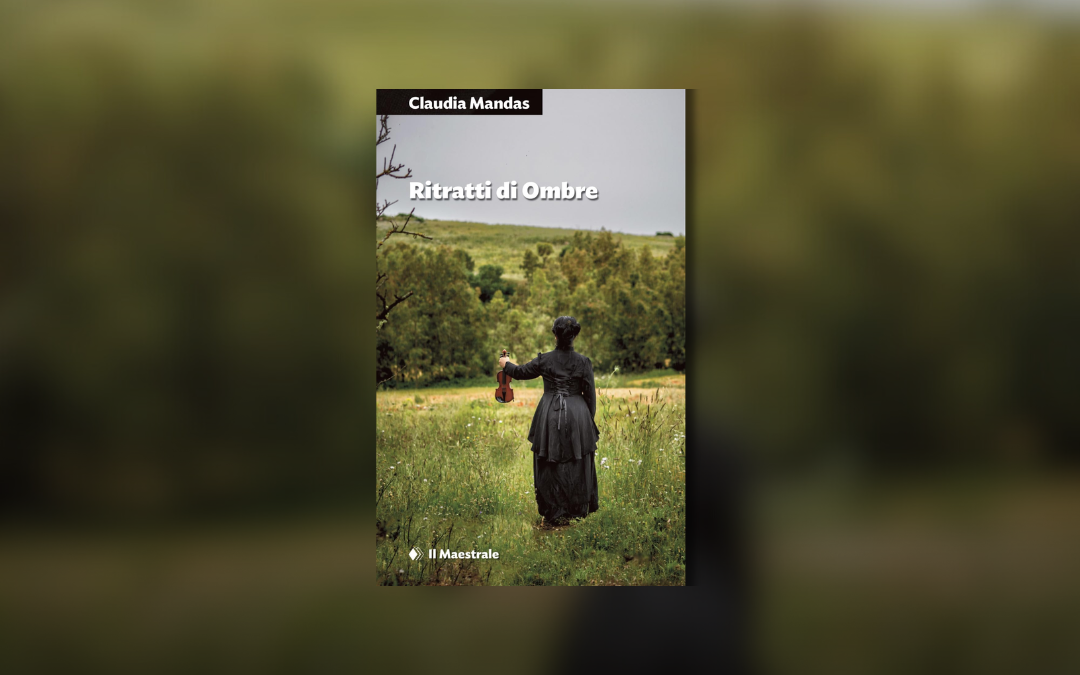
Ritratti di Ombre
Claudia Mandas, Ritratti di ombre (Il Maestrale edizioni, 2025)
With these short stories inspired by the atmosphere of the Monumental Cemetery of Bonaria in Cagliari, Claudia Mandas reconciles us with the natural cycle of life and death, turning her gaze toward the past instead of the future. In doing so, the author —who proudly defines herself as lunàdiga— dismantles the illusion of achieving immortality through childbearing.
Review by Claudia Mazzilli
In Ritratti di ombre (Il Maestrale edizioni, 2025), Claudia Mandas composes words capable of existing before they are even spoken: words as silent as a shadow sheltered from the light, like the stillness before and after life. They are woven into verses —her poetry possesses the distilled density of an epigram— and into stories that share the lapidary brevity of an epitaph. These twenty-five narratives are inspired by the atmosphere of the Monumental Cemetery of Bonaria in Cagliari and the funerary works of sculptor Giuseppe Sartorio. They are stories dedicated to fictional characters or well-known historical figures (soldiers, sailors, entrepreneurs), told sometimes in the first person, sometimes in the third, or through a small chorus assembled from the comments and gossip of those attending a wake. Others unfold in the monologue-like, dreamlike vision of a blue sea, or even in the dry synthesis of a telegram. Sometimes the narrating voice comes from the hereafter, other times from the here and now, recounting an accident, a natural death, or a chosen one.
These twenty-five stories are not at all funereal; they do not lock the writing into a chilling rigor mortis. Instead, they flow with the warmth of empathy, an awareness of the fragility of human affairs, and a profound humanitas, condensed into a rewriting of Terence’s most famous verse (homo sum, humani nihil a me alienum puto). This aching, meditative sweetness is the result of a narrative technique that works by subtraction, stripping away raw matter (the turbulence of life) to reach the perfection of existence’s final and fatal moment.
The objects that survive the deceased, Claudia writes, “possess their scent and preserve their touch” (p. 20). This same touch settles into the writing of this Sardinian author, who breathes and modulates songs of flesh and blood into “reeds filled with nothingness,” into “winds void of knots” (p. 144).
Claudia Mandas recognizes the weaknesses and miseries of living, but she does not intend to write a new Spoon River Anthology. She is not interested in judging hypocrisy or meanness, but in capturing the universality of the human condition within the unique signature of each life, through a merciful sensitivity and a capacity for identification.
“We stand on the opportunities of this or that chance, on the concessions of alignments, and on the rubble of disasters. We embrace ourselves, to avoid illusions” (p. 79).
Matrilineally, from the very first page, the author reconnects with her mother, who “taught her to love lost stories.” Why always look forward to future generations, rather than to those to whom we turn our backs and to whom, ultimately, we owe our lives? Why not recover an inter-generational solidarity that can reconcile us with the natural cycle of life and death, and with every human being, instead of projecting ourselves forward at all costs by having children, as if they were avatars of ourselves? Thus, Claudia Mandas deconstructs the “scam of immortality” that people delude themselves into achieving through procreation.
“I think back to yesterday, and the day before that, to a past now elsewhere. I stroke my belly, gently, and drag myself, an empty ballast, into the depths of a temple” (p. 129). Against “the reasonableness of things” (p. 130), the author defines herself as lunàdiga (p. 133)— bringing this word into literature (with a work that received the 19th edition of the “Antonio Gramsci” Prize!).
“Our name is lunadigas, and we are creative and creating life. We too”.
