

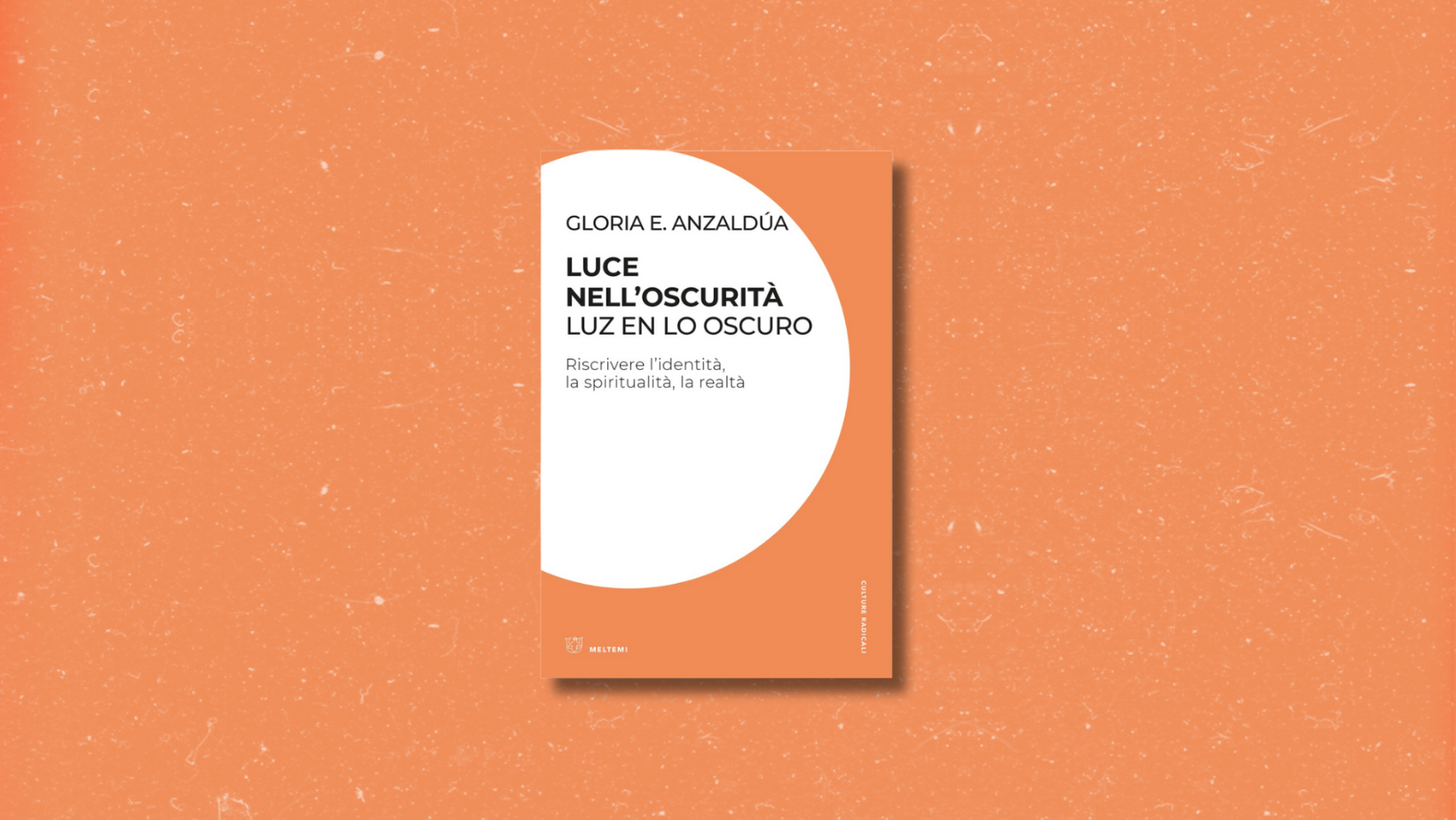
Rewriting Identity, Spirituality, Reality
Gloria E. Anzaldúa, Light in the Dark/ Luz en lo oscuro (Meltemi, 2022)
Gloria Anzaldúa describes her corporal-spiritual activism, rooted in a mestiza identity: a mobile and relational identity, a new and inclusive social consciousness, in order to heal the polarizations and contradictions that colonization inflicts as wounds upon our bodies, to integrate and reassemble the alienated and split parts into a whole that does not recognize rigid categories of class, ethnicity, or gender.
Review by Claudia Mazzilli
Born in the Rio Grande Valley (Southern Texas) in 1942 and passing away in 2004 in Santa Cruz (California), Gloria Anzaldúa was a descendant of Native Americans and Spanish settlers. She was an activist for agricultural workers’ rights in her native land, a poet, and a theorist of the borderlands concept, who also taught Creative Writing, Chicano Studies, and Gender Studies at various American universities. In her writings, she seamlessly moves from prose to verse, in a language that alternates or blends English, Spanish, and Nahuatl (ancient language of the indigenous people of Mexico), very often choosing the lexical and syntactic constructions used by oppressed, marginalized, and subaltern communities. In her writings, Gloria is able to deploy the expansive narrative typical of autobiography and historical essay, but she is also capable of condensing salient episodes of her life into poetry, drawing upon the proverbs of her people and quotations from other poets (both male and female). To define this way of writing, thinking, and narrating, Gloria speaks of autohistoria or autoteoría, in order not to be trapped by the constraints of the literary genres of the cultures that have colonized her.
Over the past few years, courageous and independent publishers have been translating and re-issuing Gloria Anzaldúa’s texts, finally making them available to the Italian public. The new translation of La Frontera (Borderlands / La Frontera. The new mestiza, Black Coffee Edizioni), edited by Paola Zaccaria, was published in 2022. In the same year, another of Gloria Anzaldúa’s works, Light in the Dark / Luz en lo oscuro, Rewriting Identity, Spirituality, Reality (Meltemi), was published (edited by Gruppo di Ricerca Ippolita, translated by Laura Scarmoncin, with Spanish language assistance from Saya Mamani, and featuring an introduction by Elisabetta Careri and a preface by Paula Satta di Bernardi). This is the work we will explore here for Lunàdigas.
Texas, Italy, the Near (and tormented) East: “people die from borders”, writes Elisabetta Careri in the introduction. These are the borders of geopolitics, but also the rigid walls that separate human knowledge, creating hierarchies and perpetuating injustices and violence. Gloria Anzaldúa (who, as a lesbian, traverses genders; who, by obtaining an academic education, experiences a class border crossing; who, as a mestiza, engages in a physical confrontation with white culture, with the Mexican one, and with the most ancient, the Indigenous one) dismantles these rigid divisions and, drawing on the Aztec language still spoken in Mexico, employs the concept of “nepantla”: a threshold-space between the living and the dead, resignified as “middle-space” where definitions of ethnicity, class, and gender lose all value. Thus, Gloria describes her corporal-spiritual activism, rooted in a mestiza identity, in a non-linear and unfinished text that represents the philosophical culmination of her thought. This activism is characterized by a mobile and relational identity, a new and inclusive social consciousness, with the aim of healing the polarisation and contradictions that colonization inflicts as wounds upon our bodies, and to integrate and reconcile the alienated and split parts into a whole that knows no binarisms. This process of reconstruction is named after the Indigenous Aztec lunar goddess “Coyolxauhqui”, “imagined not dead and decapitated, but with her eyes wide open” (p. 52). In this process, imaginative-shamanic actions, no longer subjected to white colonial rationality, promote healing. This involves a new and more accurate perception, called conocimiento or facultad: “El conocimiento urges us to react not only with traditional spiritual practices (contemplation, meditation and private rituals) or with the technologies of political activism (protests, manifestations, and assemblies), but with the amalgam of the two: spiritual activism, which we also inherited along with la sombra. El conocimiento impels us to engage the spirit to confront our social disease with new tools and practices whose purpose is to bring about a landslide” (p. 68). This means becoming “nepantleras”, integrating rational and sensory faculties to found embodied and subversive knowledges, not opposing spirit and matter as in the Cartesian split, “to observe life with the third eye – the reptile eye that looks both inward and outward simultaneously – in accordance with the perceptions of naguala mutaforma, the one who senses change” (p. 203). The Coyolxauhqui imperative is “to illuminate the darkness” (p. 52), “to heal and attain wholeness” (p. 69).
Gloria states:
“To me, writing is a bodily gesture, a creative gesture, a working from within. My feminism is rooted not in disembodied abstraction but embodied realities […] I do not write from any single disciplinary position. I write outside of official theoretical/philosophical language. Mine is a struggle to recognize and legitimize the excluded selves, especially those of women, people of color, queer people, and other groups” (pp. 49-50).
This is how Gloria challenges epistemicide, which has removed every form of “other” knowledge compared to supremacist rationality, which has been absolutized as a universally valid method/knowledge.
Quick and sharp pages flow by, in which Gloria examines events before and after September 11, 2001: wars in Vietnam, Iraq, Afghanistan; the imposition of puppet dictatorships in Latin America, Asia and Africa; international conferences on climate crisis deserted by the United States; apartheid in South Africa; the occupation of Palestinian territories by Israel… Gloria notes: “It is a misfortune that our national identity and narrative are shaped by this majority that refuses to admit that conflict cannot be resolved through war […] We are responsible for the failure of our collective imagination that offered us such mediocre choices that we were forced to elect Bush” (pp. 63-64).
Arrogance creates abysses and walls. El conocimiento creates bridges. This applies to politics just as it does to private life. This magical knowledge, practiced in daily life, produces connection and healing: “our interpretation of what is happening (our reality) is different from the description given by society, or our parents, or our lovers; their version of reality disempowers us. But creating a new self, and your life, new projects will come at a price. That price is the emotional pain of abandoning the old self, the old lover, the old job” (p. 106).
This also applies to the creation of the artist, in the name of a shamanic, “daimonic”, non-commodified but counter-hegemonic art. “The border is the place of resistance, rupture, and the assemblage of fragments. By disturbing the neat separations between cultures, Chicana artists create a new cultural mixture, a mestizada” (p. 107).
To declare a culture or an ethnicity that still (r)exists extinct is an act of genocide; it is a self-fulfilling prophecy, the very perfection of genocide, the final solution.
“It makes me furious that these people talk as if Aztec people and their culture died centuries ago when in reality, ten thousand still survive in Mexico. The museum itself is a colonized structure: it stages a kind of psychosis, implying that the entire Aztec people are dead and inhabit only prehistory. All of this arouses a dual ‘beingness’ in me: I perceive my indigenous-Mexican traits represented and at the same time I sense these parts of me are ‘eclipsed’” (p. 109).
Individual trauma and collective trauma are inseparable, but it is necessary to free oneself from victimhood, which traps us in yet another polarization: the oppressor/oppressed binarism.
“You still suffer the originating trauma of this country, the greatest act of genocide in history, the extermination of Indigenous peoples. Before the European colonizers arrived in the ‘new world’, there were between five and seven and a half million native people in the territories between Mexico and Canada. By 1900, only 250,000 remained. You are the descendant of the oldest ‘races’ in the world, thirty or forty thousand years old, and you cry out against injustice, against destruction. You mourn the devastation that the slave trade has cost Africa and the United States. You lament the loss of connection to the Earth, which groans within you for every tree cut down, for the poisoned air, for the polluted water, for the animals slaughtered to extinction” (p. 220).
Gloria Anzaldúa writes disorienting pages even for those who consider themselves global citizens, especially when she leads us through the labor of inner work, between illumination and deep plunges, in the strenuous process of spurring herself on, crossing a bridge where one sometimes advances and sometimes retreats, because the path is not carved in stone but drawn on the sand, subject to changing winds. (p. 239).
Gloria addresses a future global tribe, one that is not homogenized but liberated from fears and then ambitions of domination, endowed with a hybrid consciousness that does not pit the “us” against “them”, capable of recognizing the sanctity of every living form, a consciousness receptive to cultural differences, remodeled by interpolations and blendings, so that multiple and circular belonging are not acts of assimilation into a group. Gloria aspires to a dynamic equilibrium that sacrifices neither individuality to the group nor the group to individuality.
It is not enough to invoke liberty, participation, democracy, and human, civil, and social rights without a radical spiritual transformation, which is itself a form of militancy, not a refuge or an escape.
To learn more:
https://uniba-it.academia.edu/PaolaZaccaria
ALTAR. Cruzando Fronteras, Building Bridges, a documentary edited by Daniele Basilio and Paola Zaccaria with music by Lourdes Perez (2009): https://www.youtube.com/watch?v=Pep1vMqtHYs
