

Recognising every day the invisible sea of patriarchy
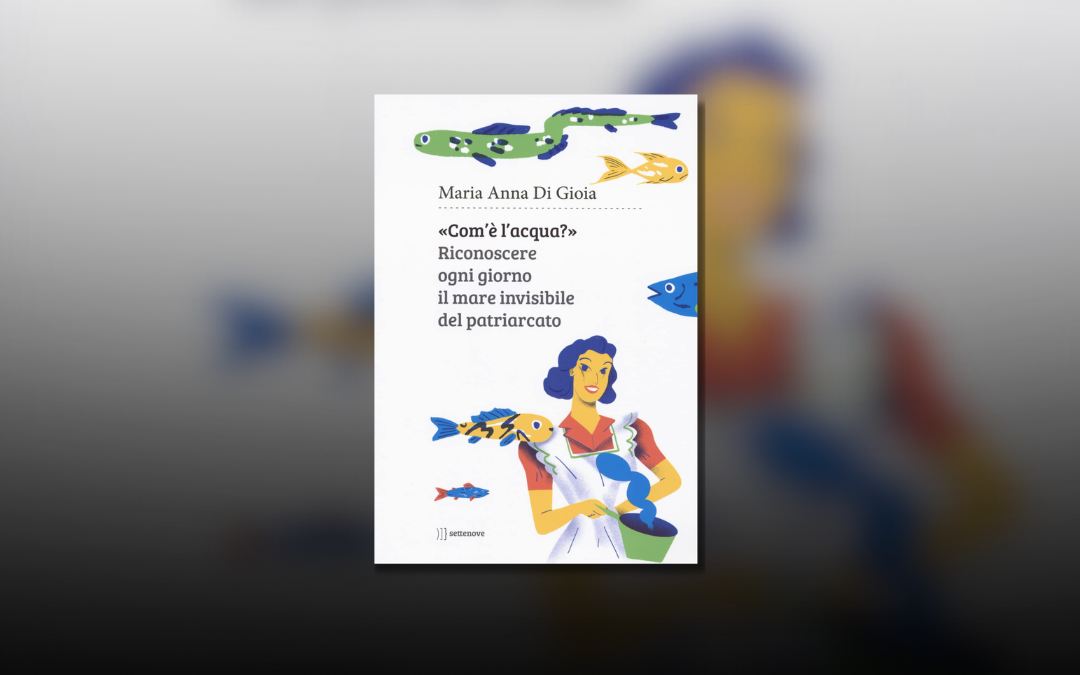
Maria Anna Di Gioia, «Com’è l’acqua?» Riconoscere ogni giorno il mare invisibile del patriarcato (Settenove, 2022)
Maria Anna Di Gioia, a high school teacher and feminist activist, brings together reflections, documents, and audiovisual materials in her work. She proposes educational workshops — complete with extensive bibliographies and webographies, most of which are available for free — designed for specific Awareness Days. In the school system, these days often lapse into mere showcase events or formal ceremonies, partly due to a lack of adequate resources.
Review by Claudia Mazzilli
Two young fish are swimming along and they happen to meet an older fish swimming the other way, who nods at them and says, “Morning, boys. How’s the water?” And the two young fish swim on for a bit, and then eventually one of them looks over at the other and goes, “What the hell is water?”
This quote by writer David Foster Wallace opens Maria Anna Di Gioia’s book, «Com’è l’acqua?» Riconoscere ogni giorno il mare invisibile del patriarcato (How’s the Water? Recognizing the Invisible Sea of Patriarchy Every Day), Settenove, 2022. The book features a preface by Francesca R. Recchia Luciani, Full Professor of Contemporary Philosophy and Gender Studies at the University of Bari Aldo Moro.
Patriarchy is invisible water and air: we swim and breathe in it naturally, almost without noticing. However, the constructs that created this ecosystem—often taken for granted as “natural”—are historical and cultural. The prejudices that shaped it can be challenged and dismantled to create a new cultural and social environment built on healthy relationships.
This is the starting point of the book by Maria Anna Di Gioia, a high school teacher and feminist activist. In her work, she gathers reflections, documents, and audiovisual materials, proposing educational workshops (complete with extensive bibliographies and webographies, mostly available for free). These are designed for specific Awareness Days which, in the school system, often lapse into mere showcase events and formal ceremonies, due to both a lack of adequate resources and, at times, insufficient teacher training. This is not a matter of blame: Gender Studies are relatively recent, and sporadic professional development courses are not enough to promote a new pedagogical vision, as those working in schools have also been swimming in patriarchal waters their whole lives.
We are not only talking about knowledge of feminist issues and the movements that championed them, but also about small details, starting with the search for more inclusive language: from deconstructing the Italian “Buongiorno a tutti” (Good morning, everybody), where the over-extended masculine form erases gender differences and excludes, to the etymology of the words “prejudice” and “stereotype.” The book also analyzes sexist language in mainstream songs and advertising (recalling Lorella Zanardo’s 2009 documentary, Women’s bodies), as well as the marginalization or absence of female writers, scientists, artists, and activists in school textbooks and even in city street names.
Maria Anna Di Gioia’s text, therefore, fills a significant gap in the publishing landscape. As the author notes: “Students are not neutral, just as teachers are not, and just as knowledge itself is not. Not only does one’s cultural and gender awareness come into play when transmitting knowledge, but also in the very selection of content to be taught, as well as in the more or less critical perspective and method used to do so” (p. 18), drawing on “noble masters,” from Virginia Woolf to Elena Gianini Belotti—who in 1973 published the pioneering text Little girls: social conditioning and its effects on the stereotyped role of women during infancy.
The book proposes educational pathways for several key Awareness Days: November 25 (International Day for the Elimination of Violence against Women); January 6 (the Befana/Epiphany); February 14 (Valentine’s Day); March 8 (International Women’s Day); March 19 (Father’s Day); the second Sunday of May (Mother’s Day); and May 17 (International Day Against Homophobia, Biphobia, and Transphobia).
Therefore, it is not only about November 25 and March 8, but also about original projects for days less exposed to “rhetorical binges,” where local municipal administrations often organize or sponsor school activities simply to appease the guilt caused by a total neglect of these themes during the rest of the year.
The Epiphany offers an opportunity to delve into the history of matriarchal knowledge, the strategic and political significance of witch hunts, and the taboos surrounding ugliness and old age. Valentine’s Day can be an occasion to deconstruct the false myths of romantic love, jealousy, and gallantry. Father’s Day and Mother’s Day can become recurring appointments to redefine caregiving roles within the family—tackling the balancing act between motherhood and work, the myth of the “multitasking” working mom, the gender pay gap, and forced resignations due to pregnancy. These days also prompt reflection on the desire for parenthood, understood not as an inescapable social obligation but as a conscious choice. For instance, the author suggests watching the film Lunàdigas, about childfree women, alongside the inexhaustible materials of the Lunàdigas Live Archive. This aligns with the book’s spirit of promoting free online resources and educating students on the intelligent use of the internet and digital devices.
In this book, theory and practice go hand in hand, just as bell hooks would have liked. On one side, there are effective glossaries and fact sheets with a legal focus (e.g., pp. 51-53, covering ius corrigendi, women in the judiciary, marital authority, adultery laws, divorce, abortion, honor killings, stalking, etc.). It also traces the events that led to the establishment of these Awareness Days with a rigorous yet streamlined synthesis of the movements that fought for rights. On the other side, there are student activities designed to engage competencies and skills. The goal is not just the transmission of notions, but the sharing of values and relational attitudes based on gender equality and circularity. This is achieved through group work that fosters socialization and experiential, cooperative learning.
I used this book for a Civic Education project with the most challenging class I’ve encountered in my entire career as a high school teacher. These educational pathways are truly feasible, modular, and flexible, adapting easily to the time and materials available in the classroom and to the specific educational goals one aims to achieve. This is an important distinction, as I often come across teaching proposals that are unrealistic or overly ambitious — difficult to implement because they are poorly calibrated (either too complex or too simple for high school students) or because they would require too much time (perhaps a whole academic year rather than a school term!).
But I feel I can say one more thing: this book is a vital resource for any educating community, large or small. For associations, after-school programs, youth centers, and, first and foremost, for families. The families of the near future, envisioned as small feminist communities, living outside the — no longer invisible — sea of patriarchy.
