

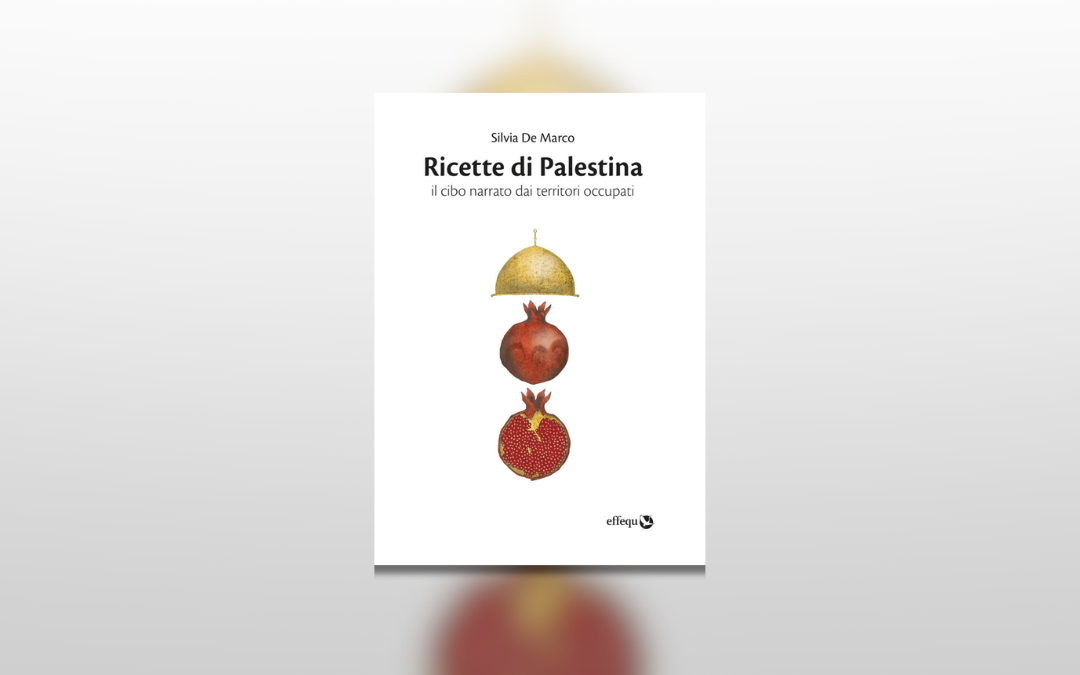
Recipes from Palestine: Food Narrated from the Occupied Territories
Silvia De Marco, Recipes from Palestine: Food Narrated from the Occupied Territories (Effequ, 2025)
Living in Ramallah for four years, Silvia De Marco explores traditional Palestinian cuisine to reconstruct a history of exoduses and returns, of borders, concrete walls, violence, and restrictions. Cooking Palestinian recipes thus becomes an act of resistance.
Review by Claudia Mazzilli
Speaking about traditional Palestinian cuisine is, today more than ever, a political act.
This is firmly reaffirmed in the note to the new edition of this book (Ricette di Palestina. Il cibo narrato dai territori occupati, Effequ, 2025, featuring splendid illustrations by ADA) by the author Silvia De Marco. De Marco lived in Ramallah for four years, working on environmental projects and educational programs for children and youth. “It is not just a list of Palestinian recipes as it might initially appear. It is the story of a people’s daily life, of their actions under hostile conditions, and of their faithfulness to a collective memory passed down from father to son,” writes journalist Michele Giorgio in the preface (the same as the 2018 first edition). This preface traces the key milestones of the Palestinian people—from the Nakba to recent events—who in recent months have awakened the dormant consciences of hundreds of thousands, bringing them to the streets in protest.
Now more than ever, as mainstream media reduces the space dedicated to Gaza, it is vital to remain vigilant and remember that disease, infection, thirst, and hunger are being used as weapons.
Thus, to ensure Gaza is not forgotten, we have chosen to review this book dedicated to food as a form of sumud—of resilience and attachment to life through the daily ritual of preparing dishes eaten from a shared plate, accompanied by pita bread, a glass of goat yogurt, or coffee. The recipes range from hummus (chickpea cream) and ful (a legume dish, mostly fava beans) to the meat-and-spice blend of kofta, shakshuka (eggs in tomato sauce), waraq malfuf (stuffed cabbage rolls), and various sauces (such as bakdunsyeh and ghazawiyeh), among many others.
The cuisine of the Gaza Strip, in particular, has fused different traditions: the Mediterranean roots of the original inhabitants and the Levantine heritage of refugees from villages destroyed since 1948. Added to this is the Egyptian influence, due not only to geographical proximity but also to Egypt’s control over the Strip from 1959 to 1967.
Every recipe calls for olive oil, set within a landscape that unites Palestine, Puglia, Greece, and every Mediterranean coast. Like silent monuments of peace, olive trees ward off belligerent conflict and call for a welcoming encounter.
The recipes speak to us of exoduses and returns, of borders, concrete walls, checkpoints, “administrative detentions,” aggressions, water scarcity or contamination, and electricity provided for only 4-5 hours a day. They speak of an inaccessible sea occupied by Israeli forces, leading to the inevitable decline of fishing (Gazawi fishermen cannot venture beyond six nautical miles) and the resulting import of fish products from Israel at double the price.
Every meal gathers something extraordinary within the ordinary: a people who remain welcoming, a seed to be saved, an indigenous variety to be guarded and passed on despite the replacement of local production with those imposed by the occupation economy.
A few years ago, while reviewing the essay collection Femminismi futuri (Iacobelli editore 2019), we learned about the work of Palestinian anthropologist and artist Vivien Sansour. In Beit Jala, in the heart of the Occupied Palestinian Territories, she founded the Palestine Heirloom Seed Library, a “seed archive” aimed at preserving biodiversity and agricultural traditions as a counter-memory to a different History.
This book carries that same power, enriched with lexical appendices and sections dedicated to films, books, music, and projects for a free Palestine. Every page, every bilingual title, is truly a political act that restores humanity.
Every recipe says to us: “Ahlan Wa Sahlan”—make yourself at home and do not hesitate.
