

Lumen
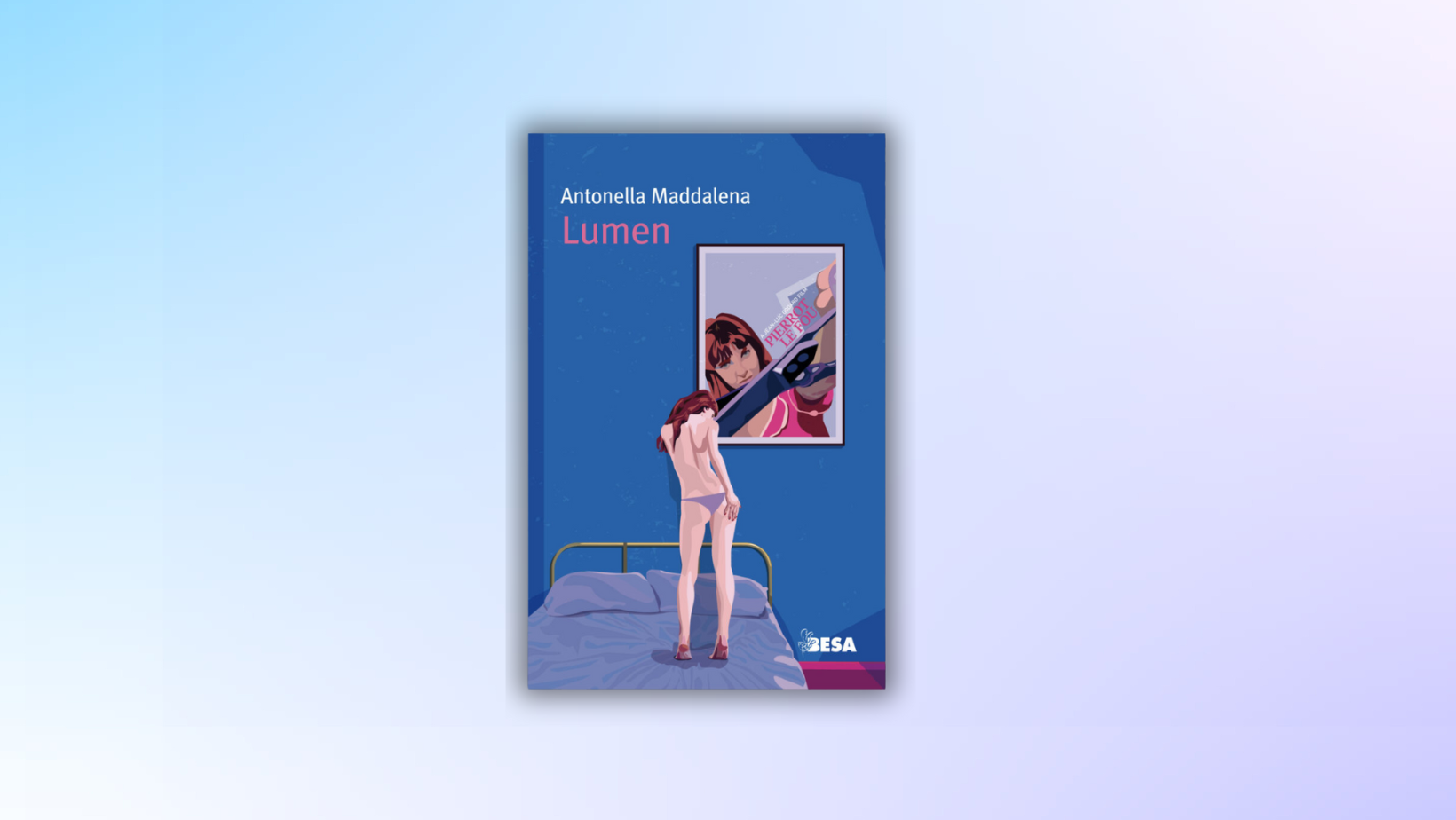
Antonella Maddalena, Lumen (Besa Muci, 2024)
Antonella Maddalena writes much more than the story of a caterpillar that turns into a butterfly. Lumen, first ugly then beautiful, discovers an indomitable, overflowing, furious eros that composes a disruptive narrative, beyond the boundaries of any patriarchal fable shaped by male desires or by the expectations of women who are their own tormentors, “ancestors of cages, blood and tears”.
Review by Claudia Mazzilli
Lumen’s face is disfigured by spots, blisters, scars, pustules and boils. Asymmetrical ears, one bigger than the other. Two bony legs without grace, “almost without calves, flat feet that felt no contact with Mother Earth” (p. 170). She also has a speech impediment. And squinty eyes. She receives neither love nor friendship from anyone, only fleeting glances that retreat into the background out of revulsion, disgust, lack of empathy, and horror at seeing their own monstrosity reflected in that of others.
The only forms of attention will be acts of bullying, by peers. Lumen does not even know the love of her parents, who never take her with them, who do everything they can to avoid her, arranging separate lunches and dinners, and, if they promise to pick her up from school, they leave her there, alone, to wait in the rain or in the scorching sun, in a burning loneliness.
“They were always on the run from this unattractive, disfigured daughter. Who looked at them badly. Obliquely. Sideways. As I was running away from my mirror. Sibilla and Agusto seemed like ordinary, respectable people, at least on the surface: friendly, though moderately distant, members of a pretentious middle class. In my eyes they were two shady characters”(p. 22).
A chemistry student, Lumen manages to create a potion that transforms her into a woman of unprecedented beauty, a potion that ‘weaned me to life, to agony, to darkness, to the shadows of my smile, to the gaps in the past, to mirrors, to the light of my eyes almost liquefied by the moisture of tears. Without surprise, I lost myself. For a moment in the beauty that had never belonged to me. I made it my own” (p. 25).
This, however, is much more than the story of a caterpillar that turns into a butterfly. The story of the ugly girl who becomes a beautiful woman is hollowed out from within and has unexpected outcomes. Lumen transforms and discovers an indomitable, overflowing, furious eros, which composes a disruptive narrative, beyond the boundaries of any predictable, patriarchal fable, shaped by male desires or by the expectations of women who are their own tormentors, “ancestors of cage, of blood, of tears” (p. 116).
Lumen looks at her friend Violetta’s pregnant belly. Lumen always chooses: “I think about motherhood that I will never experience. About the nocturnal emptiness that possesses me. About the voracity of that nothingness that swallows slow souls. About my soul, always one step away from the abyss. I think of the edelweiss that grows on the edge of the cliffs”(p. 17).
When her mother told her father she was pregnant, the lights went out all over the apartment building.
“I think my mother hated me even when I was in her womb, even before I came into the world or was just an idea. In the bud. She had done everything to lose me and she talked about it as if it were something harmless. She had exhausted herself with exercise, swimming, mountain walks, and weights. She had swallowed mixtures of herbs. Ate kilos of parsley. I was born anyway. Despite everything. I was already light” (p. 96).
Lumen is the enchantment of life, the spell of beauty and ugliness that engulfs everything and that coincides: it is the extreme control, always vigilant and calculating, it is the ardor of the senses, it is the torment and it is the anesthesia. Lumen indulges the most voracious appetites, and the first insatiable appetite is revenge, recurrent, bulimic, serial.
“Man number 9. He wanted me like a madman, a drunkard, a leech. Attached to my feet. He was the most cunning man I had ever met, with the armour of a thousand-year-old turtle. […] I think of all those calculations […] the towel with which I asphyxiated him, how much I loved him […] My hands pressed hard on the towel that smelled of lavender, while the muscles in my arms swelled. I freed him just before he could suffocate. Just five more seconds and he would be dead” (p. 37).
Lumen meets number 16 on the internet. She feels the smooth tongue of a woman mingling with hers. She loves a homeless man in every fold of her flesh. She persuades numbers 5 and 6 to put a piece of paper with a telephone number written on it into her lipstick case, which she loses and then finds again in a fancy restaurant.
Lumen experiences the power she can have over those who abandon themselves to her, but she herself experiences abandonment, love as entrusting oneself to another and uncertainty, love that forces one to stop after having gone through everything. Lumen is power but also hesitation, it is the hesitation of confidence that remains on the threshold, between word and silence: it is the fragile part of us, the waiting, the doubt of not knowing whether to tell our past, our ugliness.
“What should I tell Mael? All of it? Would he keep looking at me like that? When you declare the harm you have suffered, some feel justified in doing the same, an evocation, and begin to treat you like your tormentors. They feed on your memories and spit them back in your face” (p. 97).
The charm of this fairy-tale yet hyper-realistic narrative lies in the ambiguity of Lumen, which encompasses in her light and shadow the entire spectrum of equally monstrous beauty and ugliness, the pulsating carnality between lust and abstinence, between appropriation of the other and expropriation of the self. Beyond all binarism, beyond the love that is received and given, beyond indifference, domination and impotence, beyond revenge and beyond the arrogance of forgiveness, Lumen regenerates herself in a tertium, recreating herself in a new, hybrid, all-encompassing dimension, narrated in an eloquent yet elusive language: a universal yet enigmatic story. The style is lush yet segmented in its paratactic accumulation, adhering to the evidence of things – in the description of pustules and rashes as well as bodies, perfumes and seductive clothes – but also capable of hypogean dives into memory and trauma.
Starting with Lumen’s metamorphosis, Antonella Maddalena offers a healing journey that is not sugar-coated or watered down by an easy happy ending, but rather bumpy and tortuous, with karstic and spiral paths that give equal dignity to the sinking that revels in pain, to the analgesic apnea, and to the return to the surface. Finally, a catharsis is reached that does not aspire to be definitive, that decomposes and recomposes itself, that raves and finds its way again.
The beauty of Lumen knows no moral rules or moralizing; it is foreign to the norm of self-sacrificing, maternal femininity. Lumen is the triadic moon that is born, dies and is reborn. She does not generate, but emanates from herself in a reflective act of creation. Lumen has her splendour in herself.
ANTONELLA MADDALENA was born in Bari. Lecturer in Philosophical Consulting and Theatrical Techniques, writer, actress, playwright and filmmaker, she has published the anthology Punto di rugiada and the novel L’odore del vuoto. with Besa publisher. She trained with international masters and has worked with world-renowned directors on award-winning films. With the film Bluerose, which premiered internationally in New York, she won Best Actress awards at various film festivals such as Bucharest 2023 and Cine Paris Film Festival 2023.
