

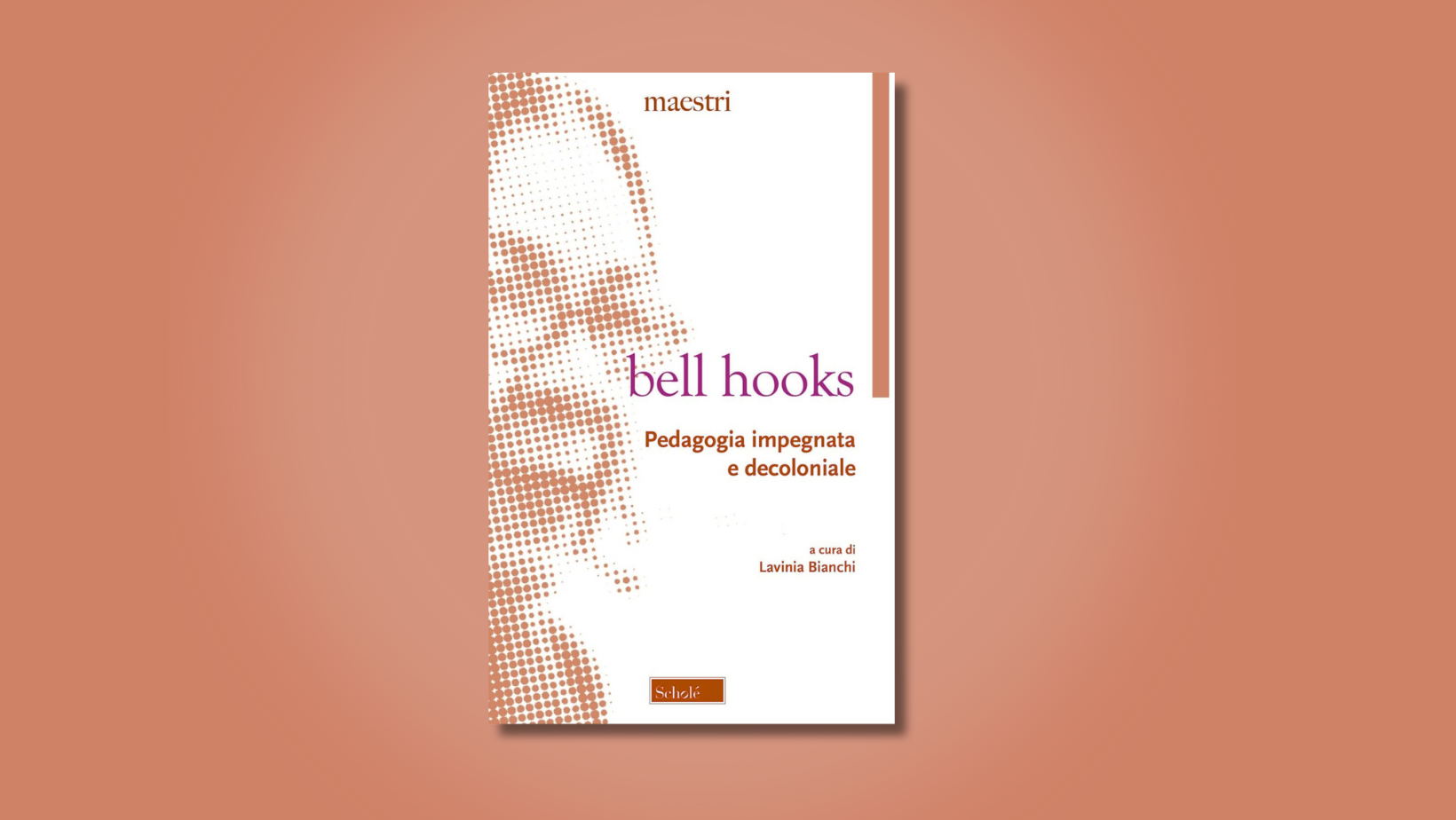
bell hooks. Pedagogia impegnata e decoloniale
Lavinia Bianchi (edited by), bell hooks. Pedagogia impegnata e decoloniale[1] (Scholé, 2024)
Lavinia Bianchi proposes a selection of interconnected themes among those dear to bell hooks, in order to enhance transformative theories and practices useful for teaching inspired by an engaged and decolonial pedagogy.
Review by Claudia Mazzilli
Lavinia Bianchi (who teaches Communication Pedagogy and Intercultural Pedagogy at the University of Roma Tre) proposes a selection of interconnected themes among those dear to bell hooks, in order to enhance transformative theories and practices useful for teaching, inspired by a committed and decolonial pedagogy. She does so first and foremost by positioning herself “as a teacher, as a researcher, as a woman and as a mother of three sons” (p. 7) and by reinterpreting the moment when, as a young educationalist at a shelter for women who had been victims of trafficking, she came face to face with the privilege of her own whiteness (p. 13). In other words, in describing her method, Lavinia Bianchi first demolishes the misunderstanding that knowledge (and teaching) is neutral, welcoming, instead, the “exposure” necessary to “teach community” and breaking the paradigms of the traditional transmission of knowledge, impersonal and repetitive:
They are the result of years of popular wisdom, psychomagic, public education, political activism, and shelters. I experienced the Arab Spring first-hand. Since 2011, I have collected and preserved stories, glances, tears, births and rebirths. I have raised my voice in the immigration offices of various police headquarters, I have written extensively about anonymous illiterate teachers, and I have taken on the cautious responsibility that those who live on the margins know how to take on (p. 76).
In presenting the life of bell hooks and in critically exploring her writings of postcolonial, feminist and intersectional theory and criticism, Lavinia Bianchi starts from herself, with these glimpses of autoethnography (a device for permanent meta-reflection on one’s own actions and on the inter-subjective dimension intrinsic to radical and transformative pedagogy). Because bell hooks is part of Lavinia’s “imaginary family” and has helped to strengthen the awareness that the educator and teacher would have: in the same way, bell hooks welcomed Paulo Freire and his concept of education as a practice of freedom into her imaginary family. Reading him, before she even met him in person.
An excellent student from a working-class black family in Kentucky, bell hooks finds her redemption in education and teaching, but she does not forget her community and feels a burning disillusionment on her black skin: racial desegregation does not correspond to democratic participation in the world and the classroom is not a space of equality, in which everyone can contribute to the free exchange of ideas, but it is a place where class, gender and racial injustices are repeated and replicated.
It is not easy to relinquish authority in the classroom, create a balanced and constructive relationship with students, present oneself as a knowledgeable but not omniscient teacher, give up the power to control what is said in class by silencing unconventional and unpopular thoughts, and rethink knowledge as a resource that strengthens the common good and the possibility of radical change: because truth is co-constructed, relational and never absolute, and knowledge and tradition are always the result of social conflict.
Rethinking the school curriculum, writing diaries and autoethnographic memos, group work, illustrated books for children, shared reading, and the study of intellectual works by marginalised groups, to be valued as political subjects of resistance and re-existence, can help school and academic teaching to break free from colonialism and to “transgress”, that is, to shift – in the etymological sense – from an ethnocentric position to an ethnorelative one. Education is always a political act: this also applies to academic writing and all forms of socially engaged writing. bell hooks states that she writes with the intention of sharing ideas in such a way as to make them accessible to as wide an audience as possible, seeking not to make the ideas less complex, but to make what is complex clear: clear to students, abused women, prisoners. Only in this way can language cease to be complicit with white, ableist, patriarchal capitalist supremacy, which engulfs everything, domesticates and neutralises everything, in order to continue oppressing.
Committed pedagogy means unlearning practices of domination, violence and oppression, subjecting them to radical and intersectional criticism, incompatible with hypocritically charitable, pietistic and paternalistic humanitarianism.
Engaged pedagogy means deconstructing the mystique of the “common oppression” of all women built by white feminism, which conceals the responsibilities of racialization and class privilege, limiting itself to co-opting black women into sharing a blurred narrative that invokes sisterhood among victims and does not undermine sexist ideology. For example, bell hooks disputes that women are “by nature” opposed to war and imperialism, as guardians of life and mothers: she rejects this biological aetiology, which reinforces sexism and ignores the fact that women and men receive the same patriarchal education, even though they are destined for different roles. Similarly, she is wary of the idea that men are “naturally” honoured to go to war, because she sees black people enlisting in the national army – of a nation that has institutionalised racism – only to find work and escape hunger. bell’s father was a soldier during World War II, but he never talked about the war. Her grandfather did not participate in World War I because he never wanted to fight in someone else’s war. Once again, bell hooks makes us understand that any discussion of gender that does not also address issues of race and class is incomplete and flawed.
Engaged pedagogy is interconnected with a conception of love that is irreconcilable with violence, which is exercised in all social structures, starting from the family, which is too often the only institutionalized sphere of power authorized to be quietly autocratic and fascist, a place of spatial confinement for women through the internalization of enclosure and the invention of nature, perpetually legitimizing gender stereotypes.
Embracing engaged pedagogy means exposing oneself, rejecting the overly specialised micro-language of textbooks, rejecting Eurocentric narratives, finding liberating and generative words for everyone, bringing private words to the surface in public discourse, words charged with personal experience, neither abstruse nor abstract, understandable to all, because language is a place of struggle, writes bell hooks on several occasions, who as a young girl was struck by a phrase by Adrienne Rich: “this is the oppressor’s language, yet I need it to talk to you”. Words that are not nostalgic for the time and space of the oppressed, of the victim, in the name of their supposed purity, but words that resist oblivion and make the margins a space of radical possibilities, a counter-language in which to imagine and invent alternatives, often proceeding by trial and error, improvising, acting out forms of resistance, becoming not objects of domination but subjects of change. Thinking back to the rail tracks beyond which lay the white neighbourhoods where black women could only work as maids, caretakers, or prostitutes, reconnecting matrilineally with her oppressed and illiterate ancestors, bell hooks calls us from a place on the margins, a place where she is and feels different, where she sees things differently. Thus, she composes her eulogy of the margin, a place of creativity and power, an inclusive space, in which we find ourselves and act with solidarity, to erase the colonized/colonizer category.
Even today, in the age of artificial intelligence, rearmament, old and new nationalisms, a few years after bell hooks’ death, her pedagogical and spiritual legacy looks to the future. Her invitation to move from a society based on things to a society based on people is very timely.
Lavinia Bianchi encourages us to return to bell hooks in these very difficult times, when as women, as mothers or non-mothers, as daughters, as teachers, as activists we may feel tired, afraid, resentful. Her selection of themes and texts by bell hooks helps us transform fatigue, fear, resentment into a political engine, into a transformative energy.
[1] Translator’s note: Engaged and Decolonial Pedagogy.
NOTES:
It is not the first time that Lunàdigas proposes ideas for reflection starting from the works of bell hooks; for further readings:
https://www.lunadigas.com/en/thoughts-and-visions/bell-hooks-teaching-to-transgress-education-as-the-practice-of-freedom-a-review-by-claudia-mazzilli/
