

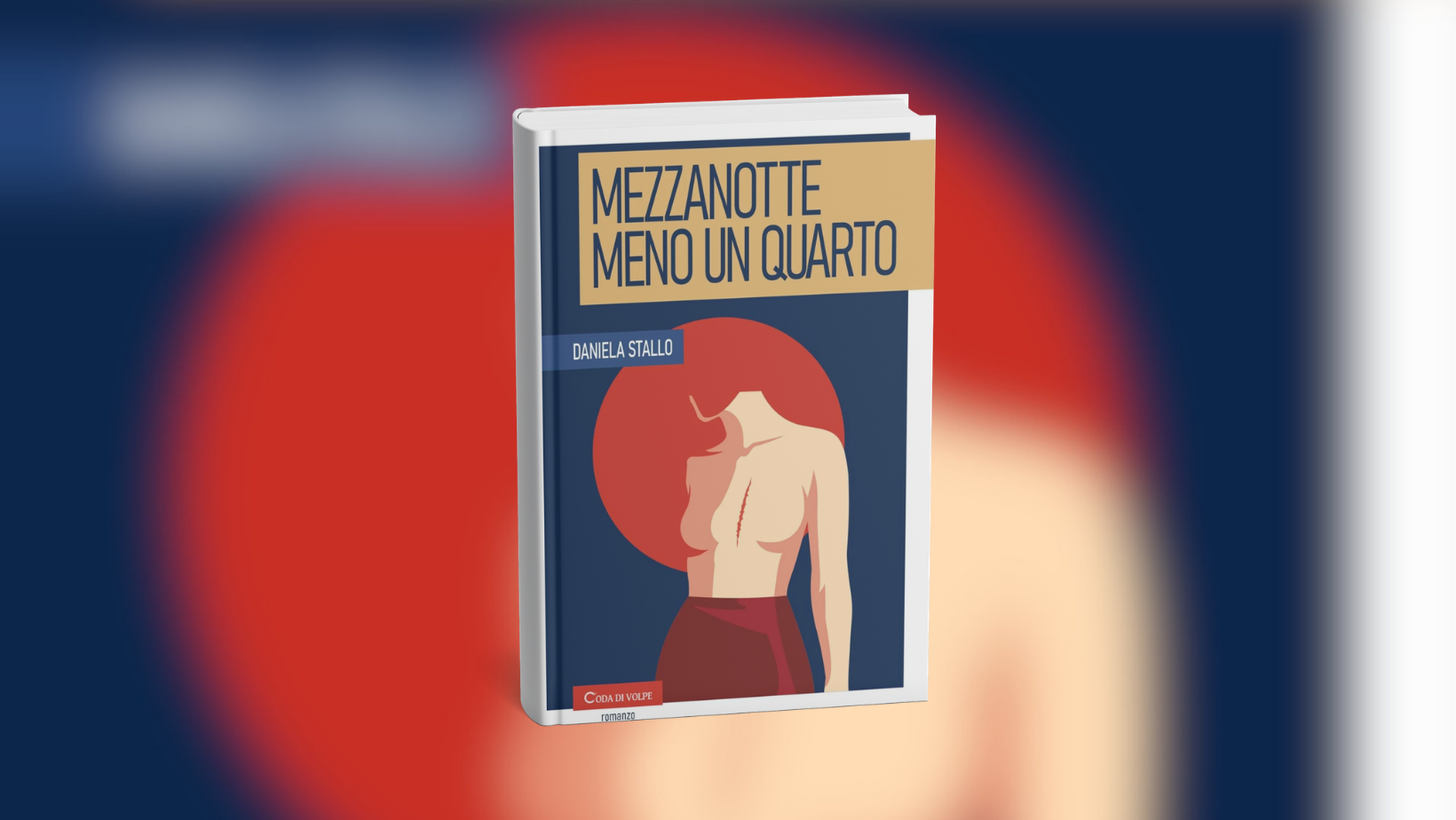
Mezzanotte meno un quarto
Daniela Stallo, Mezzanotte meno un quarto (Coda di volpe, 2026)
In her novel Mezzanotte meno un quarto (A Quarter to Midnight), Daniela Stallo tells the story of a voluntary termination of pregnancy set in the 2000s, against the backdrop of the ambiguities of Law 194/1978, amidst obstetric violence, persistent gender stereotypes and irreversible ecological devastation.
Review by Claudia Mazzilli
“They ask me if I have children. ‘How many children do you have?’ They don’t ask if I have children, but how many I have, as if the very idea of not being a mother were completely unreasonable. Generally, I can choose between two possible answers. Any number: twelve, twenty-five, one hundred and eighty, I say – the total number of current and former employees – and they give up, happy with such a display of affection. […] Or I say, ‘Does it matter?’, with a smile […] That morning, however, I had said, ‘None.’ ‘I don’t have any children,’ I had reiterated. Once they’d taken note of the information, everyone had gone back to their business” (p. 11).
The story Daniela Stallo tells in Mezzanotte meno un quarto (Coda di volpe, 2026) is rendered with both raw honesty and sensitivity. With precise words, rooted in bodily memory, the author skilfully outlines the contours of the story: due to her gynaecologist’s negligence, the protagonist undergoes a series of diagnostic tests far too late, which reveal numerous malformations and conditions affecting the foetus, as well as risks to the pregnant woman’s life. The woman manages, by a hair’s breadth, to fall within the timeframe permitted by Law 194/1978 to voluntarily terminate her pregnancy, navigating bureaucratic quibbles and loopholes suggested by the medical staff themselves in a curt manner, amidst a stingy display of any form of empathy towards the patient – a parsimony of gestures and words that often amounts to outright obstetric violence: pens slammed on the table, reprimands, sarcasm, a lack of privacy, needles inserted haphazardly, and the beds of women terminating their pregnancies placed right next to those of new mothers.
Daniela Stallo, a law graduate, secondary school law teacher, journalist and freelance writer, does not succumb to the didactic temptation to explain the limitations of Law 194/1978 (which must be defended, but which needs to be updated and strengthened to truly guarantee the right to self-determination), nor does she give the narrative the hybrid form of a narrative reportage; she refrains from digressions and chooses, instead, to be a pure storyteller, allowing judgement to emerge freely from the reader’s own sensibilities, starting from the facts presented in a concise manner.
The result is a narrative which, in just over a hundred pages, gallops swiftly across multiple temporal planes and stylistic registers – ranging from memoir and pamphlet to the dry chronology of a medical record – without lingering too long on any single narrative mode. The first-person narrator does not point fingers, does not put anyone in the dock, and does not take on the role of either prosecutor or judge. Above all, she carefully avoids adopting the stance of a victim. Rather, she is concerned with deconstructing from within the concepts of family (beginning with her own family, her ‘non-parents’, her spinster aunts and her nun aunt), the very aspiration to motherhood (an authentic desire or a ‘box to tick’?), and the ‘family dogmas’ according to which ‘there is no such thing as life, there is only duty’ (p. 83), and the models of Catholic and conventional upbringing that the protagonist has internalised and from which she has not always managed to free herself, drawing constant opportunities for critical reflection from the event that her body periodically brings back to mind via a scar on her stomach. These reflections lead her to a new awareness which, however, does not soften the solitary and invisible pain, does not result in compromise, and does not lead to any catharsis: emancipation is never achieved once and for all, because, to quote Antonio Gramsci, cited in the epigraph, ‘One must speak of a struggle for a new culture, that is, for a new moral life that cannot but be intimately connected to a new intuition of life, until it becomes a new way of feeling and seeing reality.”
The happening, then, becomes ‘the boundary that separates a before from an after’ (p. 55): ‘happening’ is the term used by the author, and this is the title of Annie Ernaux’s novel, to which Daniela Stallo makes an almost explicit reference, thereby giving her writing a significance that is not merely literary but political: speaking out (publicly, and therefore politically) on a subject that still smacks of reticence, censorship and outright taboos.
“At first, I thought it was bad luck, then a disaster. I was writing a book that was almost a duplicate, a book which, in the same way, had a bathroom scene as its crucial moment. I had shared some of the author’s journey; that was October 1963 and mine was a January in the first two decades of the 2000s, and as I read it, from the perspective of my own narrative—that of the present day— I suddenly realised we were still there: things that happen at night, in bathrooms, matters of blood, quack doctors, orderlies, beds, futile words of consolation, pains that are discredited, debased, devalued, the pathetic affairs of little women. Then the film came out too, and it won a major award. I thought, ‘Just as well; it might do some good to have something written fifty years later, with a bit more anger, different words – her so tough and proper, whereas I think nasty thoughts and use foul language, because that’s what springs to mind – nothing’s changed a bit’ (pp. 12–13).
The protagonist-narrator refrains from seeking to blame anyone, but the book concludes with an unequivocal explanation of the causes of the foetus’s malformations and medical conditions.
Women who wish to terminate a pregnancy are still stigmatised today, decades after the passing of Law 194. Yet there is not enough discussion of what it means to bring a child into the world in parts of Italy that are facing serious ecological crises: Seveso, Taranto, the Terra dei Fuochi (between Naples and Caserta), to name but a few. Whilst pro-life organisations continue to refer to abortion as infanticide, the ecocide goes unnoticed. A person’s right to be born and to live healthily in a healthy environment: these too, and above all these, are reproductive rights.
