

Women breastfeeding wolf cubs: icons of hyper-motherhood – Review by Claudia Mazzilli
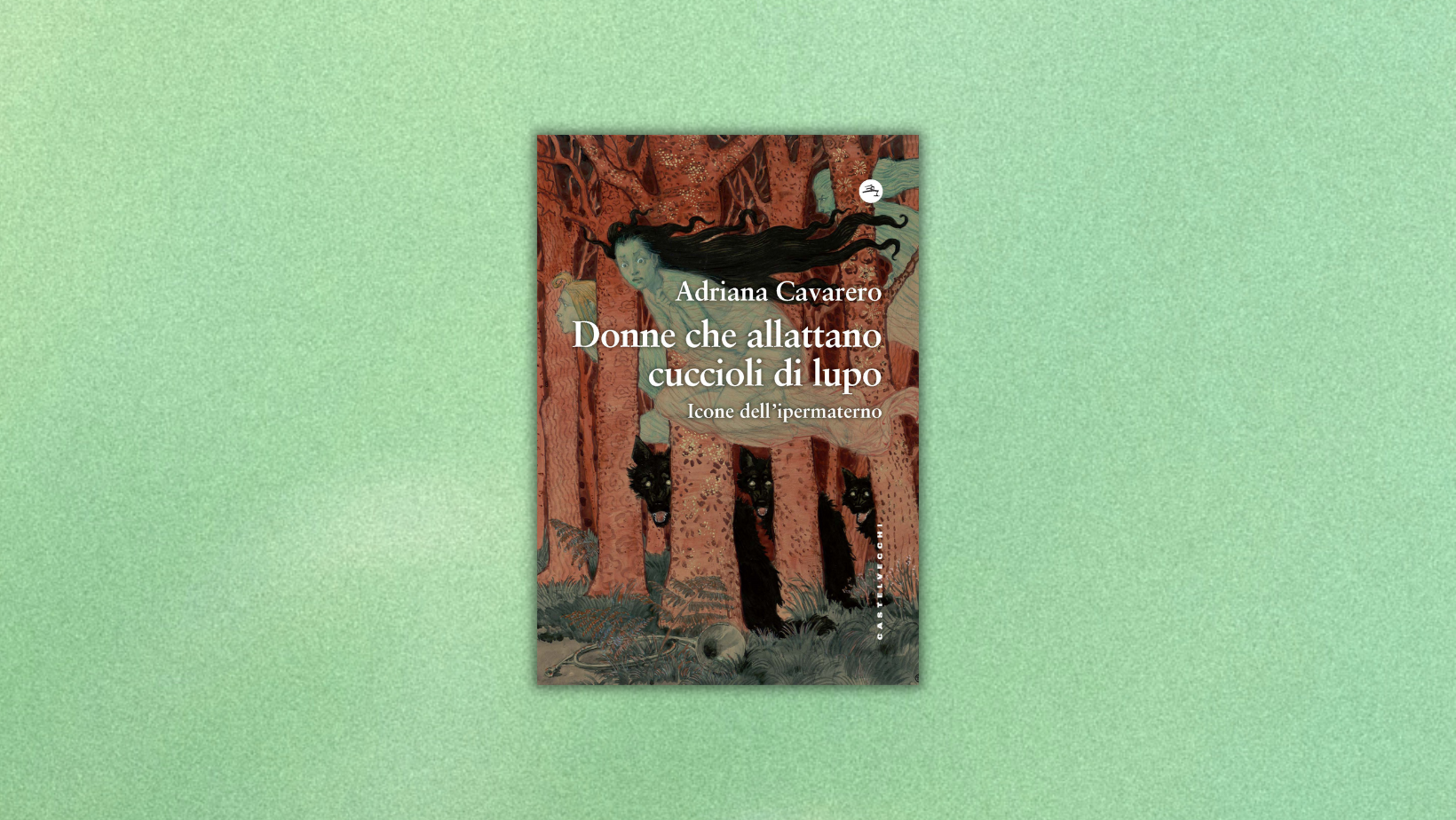
Adriana Cavarero, Women breastfeeding wolf cubs: icons of hyper-motherhood[1], 2023.
Adriana Cavarero overstepped the bright – and entirely patriarchal – representations of oblative motherhood and explored the dark, lively and visceral side of giving life and being born.
Review by Claudia Mazzilli
Motherhood is such an idyll.
This is the bright – and entirely patriarchal – depiction that Adrian Cavarero circumvented, examining instead the dark, lively and visceral side of giving life and being born.
To the oblative motherhood of the Madonna with child, Cavarero prefers the mother-daughter relationship, which she examined in another book (Nonostante Platone[2], already reviewed by Lunàdigas) in the Demeter-Kore couple, but also in the relationship between Antigone and Jocasta (it is no coincidence that the philosopher Marìa Zambrano, in her theatrical text La tumba de Antígona[3], identified uterus and tomb). The relationship between Antigone and Jocasta is “terrible”. Jocasta is a disquieting hyper-mother, as she’s the mother of Antigone but also the mother of Oedipus, father of Antigone, due to the incest.
Every mother-daughter relationship remains essential, “even if the daughter never gets pregnant and never gives birth[4]”. Therefore, against the abstract patriarchal thinking, it is in the mother’s body that originates our incarnated singularity.
“I’m talking about feeling to be a mother at the price of excreting a living fragment from the body”, as Elena Ferrante wrote[5], “I’m talking about feeling to be a daughter as fragment of a whole and incomparable body”. Because, through motherhood, a woman not only comprehends that we are all flesh of each other’s flesh regardless of our species, but also that the flesh, in the cosmic communion of the living, always differentiates into a unique flesh (these are Emanuela Coccia’s considerations[6]).
The birthing experience (in Italian, the word parto – birth – is etymologically close to parte, which means “side”; therefore, she talked about the differentiation into the unique and the contingent) and the infant care experience make us discover the human animality, but also the cosmic animality, which surpasses the bios and takes part in the infinite and inhuman (or not only human) zoé of the continuous regeneration of the living. Without, thereby, considering the animal woman inferior to the spiritual man, rather keeping in check the anthropocentric paradigm, which is always androcentric. At this point, we’re beyond Simone de Beauvoir, who would consider motherhood a natural curse which, through reproduction, fatefully binds the human female to Nature and to Life, that is the natural functions, giving instead the man the biological privilege of being able to dedicate himself to creative activities.
With no fear of venturing into a politically incorrect speech, in search of hyper-motherhood icons, Cavarero traced the history of philosophy (which since Plato, with the maieutics, with the ability to generate ideas and arguments, has taken possession of the “female gender” in a ventriloquist game which, however, erased the female body). Cavarero reinterpreted the myth (Niobe’s hyper-prolificity and her hybris) and the classical tragic theatre, traced links with dionysism and, prior to that, with the cults of the Great Goddess, restoring Marija Gimbutas’s honor, whose legacy is still unfairly marginalised in academia.
The philosopher went through modern and contemporary female narrators’ writing, who enhanced an experiential approach to the biological (Clarice Lispector, Elena Ferrante), recounting a non-reassuring nor trained motherly, a motherly bursting with life, not submitted to religious and social stereotypes, which generates, but also refuses to generate (Annie Ernaux who recounts abortion in L’Événement[7]). Because, as Cavarero wrote in her book quoting Fanny Söderbäck and her reinterpretation of Julia Kristeva and Luce Irigaray, “the point is not that all women are or should be mothers, but rather that all human beings, at least until now, were born from mothers[8]”.
The peak reasoning of her work is found in the chapter which gives it the title, based on a verse by Euripides: “women breastfeeding fawns and wolf cubs” are the followers of Bacchus, who leave their domestic spaces and offer their breasts swollen with milk to cubs of wild animals in a nourishing fervour that gets them immersed in the nature, likewise generous with milk, wine, and honey gushing from the land, without needing the anthropocentric farming techne, in a food paradise which is not oleographic, but is overwhelming, crossed by ecstatic inebriation, beyond any limit, including the limit which separates the human from the animal not only when the followers of Bacchus are nurturers of animal cubs, but also when they become unrestrained hunters who, in their hunting fury – again lacking the anthropocentric techne –, kill and dismember Panteo with bare hands, mistaking him for a lion, in the utmost confusion between human and animal.
“The image of Agave dismembering her child with bare hands and proudly lifting his head on a cane still seems to go beyond the limits of any misogynist representation of mothering; actually, it seems to go far beyond the limits of that ‘motherhood without limits’, that precisely the Euripidean Bacchantes symbolize. By pushing hyper-motherhood beyond its constitutive hyperbole, the story ultimately touches something unprecedented, something that goes well beyond the usual canons of misogyny. Penteo’s dismemberment shows the delirium of a hyper-motherhood which, although already excessive, so to say, exceeds its own excess[9]”.
“Afar from positioning ourselves at the top of an imaginary hierarchy of the living, the existence of our species has random, precarious and temporary features, like those of any other species: the human animal could have not appeared on Earth and, plausibly, sooner or later it will become extinct[10]”.
This way, Adriana Cavarero reached a zoo-ontology of mothering “that ransoms the body phenomenology of motherhood from the fictions that censored or falsified it by using blinding sweetening stereotypes”[11]. Moreover, she recognized that the motherly has a cognitive function that makes us reflect on our being livings among the living, up to pushing herself towards what philosophy calls “radical ecology”.
[1] NdT: Published in Italy in 2023 by Castelvecchio Donne che allattano cuccioli di lupo. Icone dell’ipermaterno.
[2] NdT: tr. Although Plato.
[3] NdT: tr. Antigone’s tomb. Italian book: La tomba di Antigone.
[4] P. 17 in the Italian book.
[5] La frantumaglia (tr. The fragments), edizioni e/o, Italy, 2016, p. 216.
[6] Metamorfosi, siamo un’unica, sola vita (tr. Metamorphosis, we’re all a unique, single life), Einaudi, Italy, 2022, p. 5.
[7] Tr. The event. Italian book: L’evento.
[8] P. 28 in the Italian book.
[9] P. 67 in the Italian book.
[10] P. 114 in the Italian book.
[11] P. 27 in the Italian book.
