

SORRY, WHERE WAS I?
SORRY, WHERE WAS I?
By Licia UGO
August 2014, Rome
In that vast nebula where shreds of memories, fragments of a past life, sighs, scents and small events coalesce – events which, at the mere appearance of a color, suddenly come to life again and come together to form a complete image, like a freeze-dried compound that swells and comes back to life when immersed in water – well, in this vague, cerulean substance we call memory, the recollection of our first meeting has fused around a particular day, a sea and a sky from so many years ago, when I was ten and you were twenty-seven.
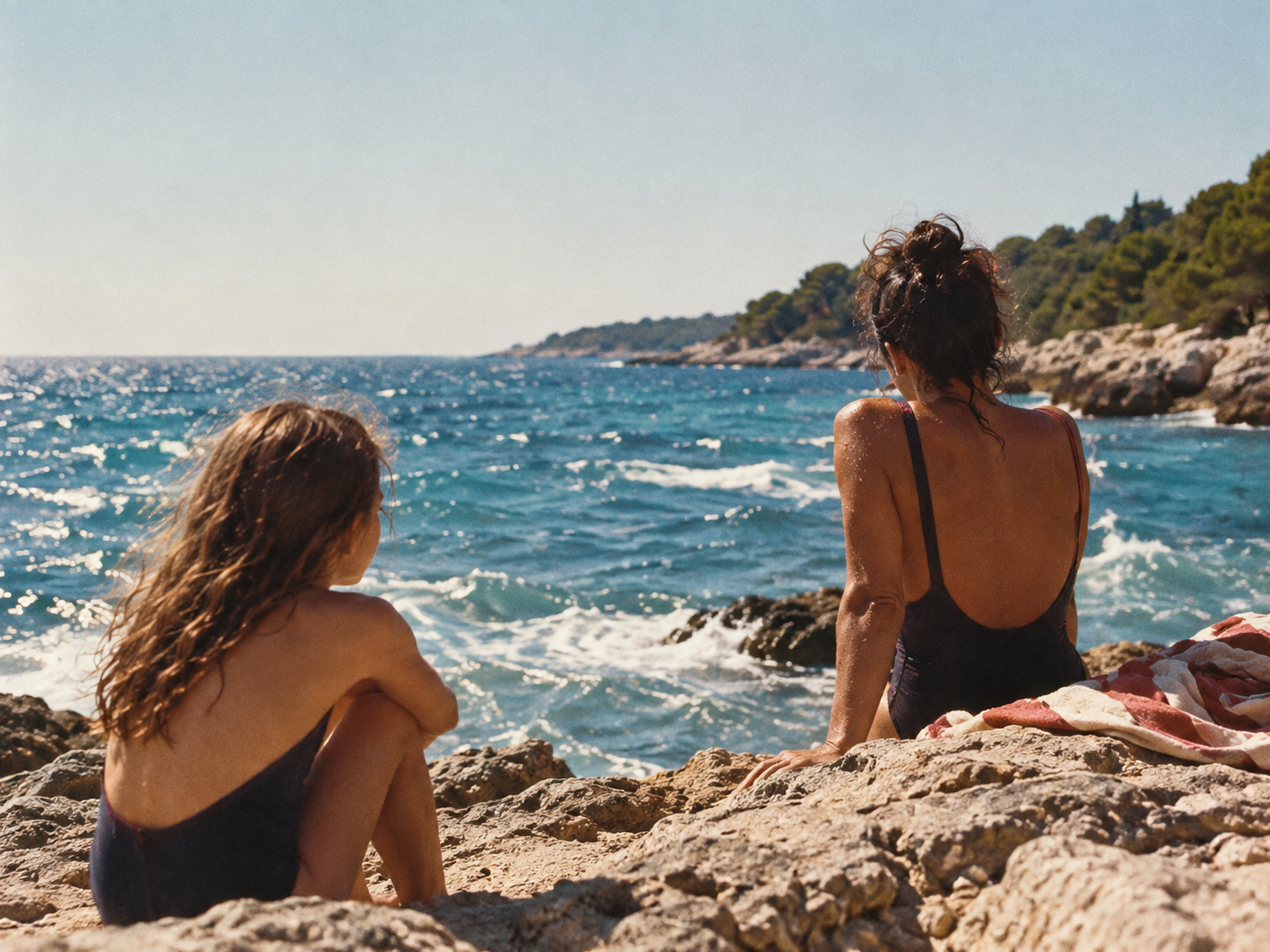
The water is that of the sea in July, but it’s a rather windy day, and the water is choppy, full of little white waves that curl up – they’re called ‘whitecaps’. In the distance, the dense pine forest along the coast glistened and shone, whilst low pine trees on the rocks crept almost right down to the shining sea.
I can still taste the saltiness of the sea in my mouth, and I can picture the white, salty streaks running down my tanned skin.
I remember the first time I met you; I remember it clearly, even though in my memory everything blends around a specific moment – always the same one – which isn’t actually our first meeting, but a day spent by the sea in Saccorgiana, Istria.
It’s always summer when I think of you, and you’re just about to come out of the sea after a long swim, or you’re about to go in.
I walk over and ask, ‘How was the water?’,
‘Ahh, my dear, ma-gni-fi-cent.’ And as you reply, that particular shade of blue in your eyes lights up and ripples too in tiny waves; the water was magnificent… yes, ma-gni-fi-cent. And as you speak, your voice whispers, it drops; it’s almost as if you’re confiding a secret – a secret you can’t wait to reveal at the same time – and your voice rises and swells in that final drawn-out word, ma-gni-fi-cent!.
You always reply like that, even now, and so many years have passed since I was ten and my eyes widened the first time, I saw you.
Over the years, one of my few certainties rejoices and grows stronger; I ask you this on purpose. I stand there, waiting, on the lookout, to catch that little sparkle in your eyes, to hear that slight catch in your throat, that hoarse sigh, that answer that’s always exactly the same: ‘Yes, the water was maa-gnii-fi-cent’, and Pola, as always, incredibly beautiful.
I’m looking forward to it, savoring the moment when you’ll tell me about your seaside holiday. For years, Pola has been an unmissable stop, and your stories never disappoint me, even if you tell me that last time the weather wasn’t perfect – well, in a way it was all the same, because even that swim, with the leaden-colored water before the downpour – expected, yet unforeseen – of rain, well, even that was perfect, and the sea was like honey, sweet and warm, and it enveloped you completely, and every stroke carried you far away. And from there you looked at the shore with salt in your eyes, and waved to your friends, lying on the beach and waiting to see you return, to chat, and to say, ‘Look at Franca, she’s still swimming, and it’s about to rain!’, only vaguely annoyed by your absence, yet pleased to have such an intrepid swimmer as a friend.
Having left Australia, where I’d lived until I was ten, – I still remember those wild and dreamlike years, spent on a farm far from the center of Sydney, where I’d return at the end of each day spent at a boarding school, – so, having left Australia, sadly, we came back to Italy.
In the Australian bush, I had the freedom to run wild, marveling at the fragmented, yellow, powdery explosion of Australian mimosa – woods like deconsecrated churches full of columns with smooth, white bark – wandering in search of translucent snake skins left to dry after shedding.
On my return to Italy, I therefore had to face a double blow: the death of my mother and coming to terms with the reality of life in Italy. In particular, I came to understand the provincial and narrow-minded mentality of Italy in those years, and ended up living in that part of central Italy for a full three years, confined to my paternal grandparents’ home.
There were few rays of light; life had taken on a bitter taste, if not verging on bitterness itself. And my regret for the life I had lost took on the purplish hues of the priest’s cassock as he said Mass at sunset, in a dark and cold church where I constantly found myself going. Against the backdrop of the altar, I watched the faint flickering of a few candles amongst withered lilies and breathed in a musty odor that lingered in the air, hoping it might soothe my sorrows.
I wanted to believe in the miracle – the one that was taken for granted for those who adhered to proper religious practice.
There were no miracles, but Franca came into my life.
“This is Franca Gianoni, your cousin,” and then came a whole string of names – relatives and friends – and finally Rudi and Mery, Franca’s parents.
For a ridiculously long time, I believed your surname was Giannoni with two ‘n’s’, until one day you patiently explained to me that no, it meant ‘descendant of Giovanni’, Ioanovich or something like that in German, and so there was actually only one ‘n’.
I remember my father – back in those distant years, on that first holiday in Istria, in Pula, where he took us on a tentative pilgrimage, having just returned from Sydney – had filmed some home movies of those holidays in Istria, in Super 8 format, and it was then that I saw the sea at Medulin, Saccorgiana and Rabaz for the first time.
That summer, at the age of ten, thanks to my blonde cousin Franca, I learnt to swim, and the sea at Pula will always be, for me, the most beautiful sea, truly the only “sea”.
I remember being ten; I vividly recall the first time I saw your yellow sandals. I was dazzled by them; even today I can still feel the texture of that Napa leather – rough yet soft at the same time – and I can picture that whimsical, revolutionary color, back in the 1960s when sobriety reigned supreme, and women sought – even with a pair of yellow sandals – to challenge the established order.
A color that still represents transgression and freedom to me, and buying yellow Napa leather sandals has been, for many years, a way for me to celebrate you.
Back then – well into the sixties, but still the sixties – that’s how we used to put it: ‘the established order’ was a phrase that implied things needed changing; nature was not destiny; we had to fight for social change; things, as you used to say, could and must be changed.
Your pupils, dear ‘profff’ (we’d put three ‘f’s in there when saying it), always came first; your dedication, your commitment to learning, and your iron will to improve the lives of others was something on which you would not compromise.
In your first white Fiat 500 and your immaculate yellow sandals, every morning you’d clock up about ten kilometers, travelling from Gorizia to Cormons for your pupils.
The days of the yellow sandals and the white Fiat 500 (I can’t remember now whether it was number one, two or three, you’d had many) were the days of my first ever cultural trip: Urbino, where we went together with your friends.
We arrived in Urbino after a quite disheartening setback, when, to the cries of ‘The alternator! The alternator!’, the poor, worn-out Fiat 500 let out one last gasp and came to a halt halfway up the slope between the valley and the little hill of Urbino.
But even that, I soon learnt, became an adventure rather than a misfortune, and in that grey room with no doors or ways out – where part of my life unfolded in those years – you would arrive and, time and again, open a door or a window, letting in the light of culture.
A cone of light illuminated the world of music when, flushed from the heat, I sunk into velvet armchairs that pricked the bare skin of my arms, marveling in the heavy, reddish darkness of the theatre, as I listened to my first classical concert in Bologna, where you would later live for so many years… and so would I.
A gateway to the world of literature lay in the parcel of books that arrived for Christmas, books that for a while satisfied my hunger for reading – a craving I would sometimes quell simply by reading and rereading the old issues of Domenica del Corriere that lay in a pile at my grandparents’ house.
Looking back in time, back into the past, I remember those Sunday afternoons when, already a yougster, we used to spend our time in Trieste at the Caffè Stella Polare, analyzing for hours the final explosion in slow motion in “Zabriskie Point”, or the subjective shot of the hand stirring a small cup of coffee with a teaspoon in Jean-Luc Godard’s film… when the swirl of the coffee seems to be the nebula of the universe, and the voice says:
“I have to listen, more than ever I have to look around me at the world, my fellow creature, my brother.” The beauty of that scene has never left me.
Those afternoons were my first glimpse into the world of cinema, sipping small Trieste-style cappuccinos and smoking merrily on those gloomy winter days in the gilded Historical Cafés of Trieste.
It was then that I noticed in you, a passionate narrator of stories of all kinds, a quirk that, swinging rapidly across the spectrum of emotions, could come across as either very endearing or downright irritating – all the more so the more interesting the story you were unfolding.
I can still picture that gesture of yours, mid-sentence, when you suddenly pause, bring your hand to your mouth, your gaze wandering slightly absent-mindedly; yes, something had distracted you, but come on now!, it’s nothing much, I thought, but no – and innocently you’d blurt out, ‘Sorry, where was I?’, leaving your attentive listeners bewildered at the unexpected pause.
Yes, because it must be said that your way of telling a story – even the most minute details – has always been captivating, rooted in the present but also in social context, with historical implications, descriptions of economic motivations and so on; and all this made even the explanation of why a certain painter had used thick brushstrokes of cobalt blue during that particular period and subsequently fine flecks of gold extremely interesting.
And you’d explain that the evolution of technique had also led to different artistic forms; even a round or a flat brush could make all the difference… reality rooted in its own time.
Any interruption was frowned upon, unwelcome, but when it came from you, it was greatly feared – you could completely lose track of where the story was heading… But I’d discovered that all I had to do was hand you the last word – just that very last little word – and after a hearty laugh, with your head thrown back a little and to one side, and a light tap on your forehead as if to absolve yourself, you’d spring back into action, pick up the thread, and finish the story.
How familiar your pauses had become to me – that moment of distraction that would suddenly seize you – and how reassuring it was to know that all I had to do was reel out the last sentence, and you’d be back on track straight away: ‘Sorry, where was I? Ah yes, so…’
Another of my certainties was knowing that giving you the last word – reminding you of it – meant the story would begin anew.
Life always had something to offer you; you just had to know how to seize it. There was always a concert not to be missed, an exhibition, a book launch, a debate. Your life was rich and full. You had to keep yourself informed; knowledge was everything, the key that unlocked the world. You had to fight for social justice and opportunities for all. But, in short, your public life is there for all to see; it’s impossible to talk about it without making glaring omissions.
So, I won’t say any more about it; I’ll just say that you were always in a rush, even though you were ‘slow’ by nature.
I still don’t know how you found the time to include me in all that, but that’s how it was.
In Trieste, where I lived for a couple of years, a teenager then, I’d watch and rewatch those little summer films shot in Pula with my father; it was winter and the bora was blowing, but the best bit was always your dives, especially the backward ones, when Dad would rewind the film, and you’d leap, dry and nimble, back onto the rock from which you’d dived just a moment before, and it made us laugh.
The water glistened; the spray you sent up in front of you was white, but I thought your backward dive was even better, with the water closing up behind you and you leaping out, dry and smiling, onto the rock – a moment I wanted to watch over and over again, an impossible defiance of gravity and time.
In those frames, now gone lost, you’re standing on the rock; you’re twenty-seven years old, with very short, very blonde hair, cut like the actress in “To catch a thief”, but tousled, and you don’t care.
You’re twenty-seven forever; you tilt your head back slightly, smiling – ah yes, that’s a ma-gni-fi-cent smile, with a slightly crooked tooth just peeking out – and you dive in, bold and perfect – look!
You vanish in a cloud of spray into the most beautiful sea I know.
Years have passed and you’ve become Francona; for quite a while you remained Francona, I didn’t like those extra kilos, but you had time only for others, and you were always out and about, a beacon of certainty; you spent your life helping others. Your unshakeable faith in rationality sometimes frightens people and seems unreasonable, but it’s an engine that never stops, which led those who knew you well – our Liviana, for instance – to say, ‘What does Franca do between one meeting and the next? Another meeting.”
And off we’d go, laughing heartily.
Laughter was our way of communicating, your way of defending yourself against the darkness that lurked within others and which hardly ever touched you.
I remember once seeing you arrive home – I was living with you back then, in Via della Filanda, and never has a name been more unappealing to me, almost as much as that little house, which, come to think of it now, wasn’t half bad, but we both hated it, or perhaps it was just me – I saw you park that fantastic Fiat 500 and sit there, motionless and deep in thought, in the driver’s seat, for several minutes.
What was worrying you? School? A particular boy who needed extra help? Our relationship, which was becoming strained? Or thoughts of your mother, far away yet always present?
What misunderstanding, what disappointment drove us apart for a while? To you, I was just one of the many daughters and sons you had scattered across your world – a world made up of classrooms, pupils to save, mimeographs, motions, and desperate situations that your dedication and courage could have overcome.
There are no answers; it’s just that sometimes I find myself thinking of all your classes, of you explaining history with such passion, of that fleeting moment of distraction that would overtake you, and of how many of your pupils were able to give you the last word – or not – how many, distracted, watched the morning light streaming in through the window, whilst you, in the meantime, recovering from momentary aphasia, resumed the lesson from a different angle.
Dear Franca, your ‘short holiday in Pula’ was absolutely marvelous again this summer, just as you told me, but we are both grown much older. For a few years now, you’ve been staying at a friend’s house in Pula; the room overlooking the garden, just as you like it, and what you see from your friend Nelida Milani’s house isn’t an Italian-style garden, but a wild landscape, as befits a woman of talent who harnesses only words.
But ultimately, I still remember how, when I was small, and frightened living in Trieste, it was lovely in winter to rewind the film from those little summer movies, and I only realize now why I liked rewinding the film so much – as an expression of a desire so strong it could not even be put into words, nor fully felt – and it was the very need to be able to rewind time, to go back and back, to Australia, when Mum hadn’t yet died, and my life flowed with different rituals and rhythms.
My mind returns to that distant summer, to that simple, splendid dive of yours, performed and repeated endlessly as the film of my memory rewinds.
You are perfect in that dazzling smile.
I still remember when you turned your head and, with a nod to me—standing on the rock, forever a ten-year-old girl, uncertain, solitary and earthbound, trembling in my wet red flannelette swimsuit—without speaking, you told me that yes, one could dive into that shimmering dark water called life.
FRANCA GIANONI
The protagonist of this story is Franca Gianoni, who, as well as being my cousin, was my first example of a free, independent and hard-working woman.
Born in 1935 in Pula, Istria, from where she left in 1947 as part of the exodus, she went on to live in Gorizia whilst attending the University of Trieste.
She worked as a teacher in the area and in 1967 moved to Bologna, where she was fortunate enough to experience the most intense years of the Italian grassroots’ political movements.
In the 1980s, she became a feminist and moved to Florence, where she still lives today.
LICIA UGO
Of Istrian origin, she was born in Australia, where she remained until the age of ten, with a few spells in Italy.
She has lived in Albiano Magra, Chieti, Trieste and Bologna, and is currently based in Rome.
A graduate in Political Science from the University of Bologna, she is now retired and worked as a film director and journalist at Rai Uno. She began publishing in the 1990s, winning the Spazio Donna prize, organised by the Municipality of Striano, for her work “L’ONNIVORO”. She wrote various short stories for a number of themed anthologies, distributed by Il Girasole publishing house.
Her last book, published in 2025 is “IL BIANCO NON E’ UN COLORE” first edited by AFFIORI editions and now on KINDLE and AMAZON.
This short novel “SORRY, WHERE WAS I?” has been published in November 2014 by VITA ACTIVA EDIZIONI- ACID TRIESTE. TITLE OF THE BOOK IS “Ask the voice, women stories”.
